Pseudotranslation
 Brigitte Rath
The idea of pseudotranslation sharpens some central concepts of Comparative Literature. “World Literature,” according to David Damrosch, is “always as much about the host culture’s values and needs as it is about a work’s source culture” (283). Foregrounding a text’s imaginary origin in a different culture reads this “double refraction” as already built into a text. It thus stresses the conjecture and transnational imagination that is always involved in reading a text as world literature. Pseudotranslation as a mode of reading has also much to contribute to questions of translatability, representation, voice, authorship, authenticity, and multilingualism.
In 1721, Montesquieu published, anonymously, his Persian Letters. In the preface, he claimed that two Persians had lodged with him, and that he had translated into French the letters they wrote to and received from Persia. The dates of the letters retain Persian names for the months, and the “translator” provides some footnotes with explanations on Persian customs. The text invites readers to imagine a preceding, original, authentic text in Persian, and to picture the first audience for these letters, one that would not need the additional information provided in the footnotes, because they would belong to what was, for French readers, a markedly unknown culture. Even as it marks the foreign as opaque, Montesquieu’s text makes it readable; it plays with the readers’ voyeuristic desire to gain access to the inaccessible: private letters written in a foreign language, and an alien perspective on the readers’ familiar world.
The translation studies scholar Gideon Toury defines pseudotranslations as “texts which have been presented as translations with no corresponding source texts in other languages ever having existed” (40). In Toury’s view, pseudotranslation is a property of texts; because there was no Persian original, the Persian Letters are a pseudotranslation, whether the reader is aware of this or not. Beyond this text-centered model, I propose thinking of pseudotranslation as a mode of reading that oscillates between seeing the text as an original and as a translation pointing towards an imagined original, produced in a different language and culture for a different audience.
The idea of pseudotranslation sharpens some central concepts of Comparative Literature. “World Literature,” according to David Damrosch, is “always as much about the host culture’s values and needs as it is about a work’s source culture” (283). Foregrounding a text’s imaginary origin in a different culture reads this “double refraction” as already built into a text. It thus stresses the conjecture and transnational imagination that is always involved in reading a text as world literature. Pseudotranslation as a mode of reading has also much to contribute to questions of translatability, representation, voice, authorship, authenticity, and multilingualism.
Pseudotranslation opens up a new approach to literary texts spanning languages and periods, among them Cervantes’ Don Quixote (1605/15), MacPherson’s Ossian (1761), Markoe’s Algerine Spy in Pennsylvania (1787), Mérimée’s Guzla (1827), Holz/Schlaf’s Papa Hamlet (1889), Raja Rao’s Kanthapura (1938), Lem’s Głos Pana [His Master’s Voice] (1968), Makine’s Fille d’un héros de l’Union soviétique (1990), or Bitov’s Преподаватель симметрии [The Symmetry Teacher] (2008). This apparent ubiquity of original texts that invite their audience to read them as if they were translations merits more attention. It further strengthens, for instance, arguments for a transnational history of literature and genres since, as Aravamudan, Ballaster and Lombaz (among others) have shown, pseudotranslation shapes the development of the novel and the prose poem.[1]
Pseudotranslation is an idea of the (past) decade. Of the 154 sources that use the term “pseudotranslation,” roughly 2/3 were published in the last decade, and more deal with the same phenomenon under different names, such as “fictitious translation,” “assumed translation,” “supposed translation,” or “original translation.”
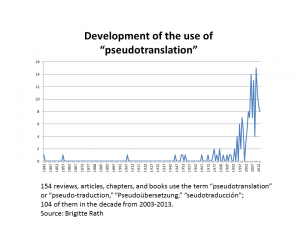
The overabundance of terms coincides with a scarcity of cross-references between the individual contributions which often show little awareness for the developing field. This seems about to change: two recent conferences focused exclusively on pseudotranslation, some articles frame their case studies more broadly, and the first edited volumes and books dedicated to the topic have appeared; the new field has reached a tipping point.[2] It may allow us to explore the allure and danger of imagining transparent opacity.