Truth to power: My time translating Behrouz Boochani’s masterpiece

Omid Tofighian
 Behrouz had text-messaged parts from various chapters to Moones Mansoubi, his very first translator beginning in 2015 and a translation consultant on this project. She would sort the texts into chapters on his instructions. Mansoubi then emailed me the PDFs – each chapter was one long text message of between about 9,000 and 17,000 words.
As I was translating from Farsi to English, I consulted regularly with Behrouz through WhatsApp. He would often add sections and make changes.
My translation process also involved weekly sessions with either Mansoubi or Sajad Kabgani, an Iranian researcher living in Sydney. While I translated, Behrouz continued to finish the book while communicating with his friends and literary confidants, Janet Galbraith, Arnold Zable, Kirrily Jordan and Mahnaz Alimardanian in Australia, and the intellectuals and creative thinkers Najem Weysi, Farhad Boochani and Toomas Askari in Iran.
Here on Manus, Behrouz reads the Farsi while I check the English. We stop and discuss sections, meanings, nuances and changes; we also digress and explore ideas, symbols, stories and theories far beyond the pages of the text. Describing his thinking and writing process, he explains:
Behrouz had text-messaged parts from various chapters to Moones Mansoubi, his very first translator beginning in 2015 and a translation consultant on this project. She would sort the texts into chapters on his instructions. Mansoubi then emailed me the PDFs – each chapter was one long text message of between about 9,000 and 17,000 words.
As I was translating from Farsi to English, I consulted regularly with Behrouz through WhatsApp. He would often add sections and make changes.
My translation process also involved weekly sessions with either Mansoubi or Sajad Kabgani, an Iranian researcher living in Sydney. While I translated, Behrouz continued to finish the book while communicating with his friends and literary confidants, Janet Galbraith, Arnold Zable, Kirrily Jordan and Mahnaz Alimardanian in Australia, and the intellectuals and creative thinkers Najem Weysi, Farhad Boochani and Toomas Askari in Iran.
Here on Manus, Behrouz reads the Farsi while I check the English. We stop and discuss sections, meanings, nuances and changes; we also digress and explore ideas, symbols, stories and theories far beyond the pages of the text. Describing his thinking and writing process, he explains:
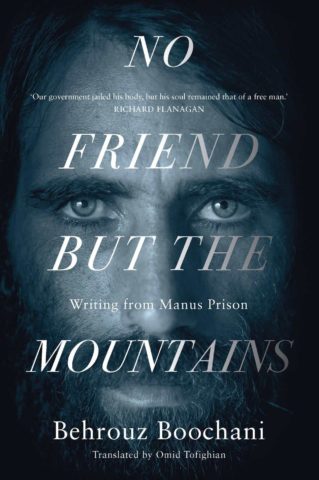
The book is a playscript for a theatre performance that incorporates myth and folklore; religiosity and secularity; coloniality and militarism; torture and borders…The translation method requires a form of literary experimentation. And the process is a form of shared philosophical activity. Trying to preserve the sentence structure when translating Farsi literature into English results in unnecessarily long and cumbersome passages. Literature written in Farsi mostly consists of sentences with many elaborate and varied consecutive clauses. The subject is at the beginning and the verb is usually placed at the end. The patterns and flow of adjectival clauses, synonyms and poetic and cultural images and allusions enable Farsi readers to move smoothly through the extended sentences due to a combination of melody, imagination, anticipation and consolidation. In English, the same chain of clauses within a sentence becomes too awkward to read, losing much of its rhythmic thrust. Splitting sentences into many smaller ones is helpful. It also reflects the disrupted and fractured subjectivity and modes of knowing of those who are imprisoned refugees. In this book, political commentary and historical account meet philosophical and psychoanalytic examination; these are framed or supported by myth, epic and folklore from various traditions, particularly Kurdish, Persian and Manusian. It is an anti-genre. I call the style “horrific surrealism”. In significant places, noun phrases and monikers are also capitalised to emphasise personhood and Farsi prose is translated into English verse. For instance:
Killing time involves a simple trick / Reach out and hold another sunset / Another one of the thousand-colour Manusian sunsets / Then, reach out and hold another night / Another one of the dark island nights / A futile cycle … / Night and day revolving / Under the shade of an old tree.Behrouz and I had a mutual understanding; in fact, the translation team embodied a kind of collective intention or shared agency. Our literary and philosophical interpretations evolved throughout the process. But the shared goal from the start was to produce a visceral narrative, a riveting masterpiece that exposed one central aspect of the detention regime: systematic torture.
Behrouz Boochani will appear by video link at Melbourne Writers Festival on August 29. No Friend but the Mountains: Writing From Manus Prison is available in bookstores and online. https://theconversation.com/amp/truth-to-power-my-time-translating-behrouz-boochanis-masterpiece-101589?__twitter_impression=true