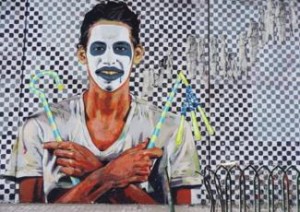
[Late graffiti artist Hisham Rizq, killed in July 2014, painted by Ammar Abu Bakr. Captured 12 September 2014]By Mona Abaza, 25 January 2015 Clearly Cairene graffiti has lost momentum during this year. Having been the faithful barometer of the revolution over the past three years, graffiti has recently faced transmutations and drawbacks that run parallel with the political process of restoring “order” in the street. The heartbreaking story of the recent death of a cheerful and bright young graffiti artist, nineteen-year-old Hisham Rizq, completes this sad picture.
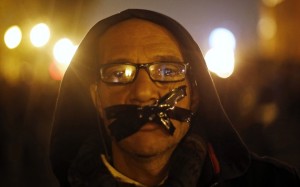
An anti-Mubarak protester in Tahrir Square, in November 2014 (Amr Abdallah Dalsh/Reuters) THANASSIS CAMBANIS, JAN 16 2015 CAIRO—Four years after the revolution he helped lead, Basem Kamel has noticeably scaled back his ambitions. The regime he and his friends thought they overthrew after storming Tahrir Square has returned. In the face of relentless pressure and violence from the authorities, most of the revolutionary movements have been sidelined or snuffed out. Egypt’s new strongman, President Abdel Fattah el-Sisi, has injected new zeal and energy into the military establishment.
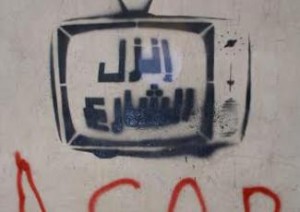
Graffiti in Cairo depicting a television with the text "Go down to the streets" Sep 05 2014 The 2011 revolutionary uprisings in the Middle East and North Africa abruptly captured global attention as the world was drawn breathlessly into the tumult with a profusion of media content, from Tweets to amateur video footage. Amidst the media blitz, analyses yielded two conflated and reactionary narratives of events. One contended that the popular protests of the so-called “Arab Spring” were wholly unexpected, a shocking diversion from the familiar politics of the Middle East in a seeming contravention of the reigning global political apathy at the turn of the millennium.
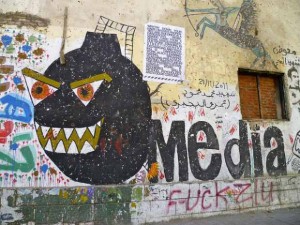
Street art from Mohamed Mahmoud Street, Cairo. (Photo: Melody Patry/Index on Censorship) Graffiti artists face threats of violence, and the potential of jail time and fines under a proposed draft law
By Shahira Amin / 22 August, 2014
Before the January 2011 uprising, street art was little known in Egypt. Then came the revolution and with it, an outburst of creativity. With the fall of the authoritarian regime of Hosni Mubarak, Egyptian artists who had routinely faced censorship restrictions under his autocratic rule, felt a strong urge to break out of the confines of their studios and reclaim public spaces.