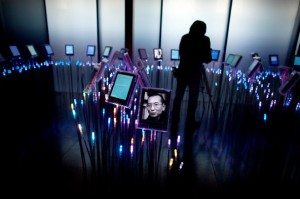
A portrait of the Chinese dissident-writer Liu Xiaobo at the Nobel Peace Center in Oslo. Mr. Liu was awarded the Nobel Peace Prize in 2010.Credit Espen Rasmussen for The New York Times The New York Times By Chris Buckley May 20, 2015 The works of the New York writer Paul Auster often hinge on ominous disappearances, and his novel “Sunset Park” has passages about the secretive detention of the Chinese dissident-writer Liu Xiaobo in 2008 and the efforts of the PEN American Center, a writers’ advocacy group, to secure his release.
Egypt Independent Mohamed Mostafa Egypt's customs services in Alexandria have seized 400 copies of "Walls of Freedom", a book depicting Egypt's street graffitti art in the context of the 2011 uprising, for “instigating revolt,” says the Finance Ministry. Ahmed al-Sayyad, the ministry’s undersecretary, told Al-Masry Al-Youm that the book contains elements that give "advice on confronting police and army forces,” therefore a cause for concern.
Heba Afify, a Mada Masr reporter. Photograph: David Degner Mada Masr was formed just before military coup of 2013. Amid growing censorship, its staff have risked their lives to continue reporting. Can they stay true to their mission? Leslie T Chang
Tuesday 27 January 2015
On the afternoon of 17 June 2013, a group of friends gathered in a fourth-floor apartment in downtown Cairo. They sat on the floor because there were no chairs; there were also no desks, no shelves, and no ashtrays.
University of Liege, 7-9 May 2015 The words ‘translation’ and ‘politics’ are so frequently used in a metaphorical sense that it can be safely claimed both that everything depends on translation and that everything is involved in politics. It is clear, however, that from the beginning the two fields, as indeed language and power, are closely related. Translation is about understanding the other and being understood, or better about conveying a message which will often be reshaped to fit a purpose, whether it be marketing, negotiations, projected expectations of a target audience, when not straightforward propaganda.
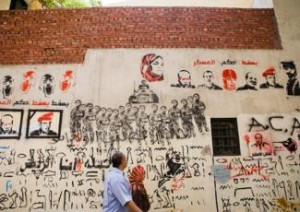
[Image from Hossam El-Hamalawy] by Hannah Elansary Sept 01 2014 The graffiti and street art of revolutionary Egypt have been researched many times over by now.Journalists and scholars have explored the phenomenon in its many aspects—as evolving visual text, as political rhetoric and as an act of protest in its own right. The claims about the protest street art and graffiti that have proliferated across public Egyptian walls since 2011 have been many, and include: the spread of revolutionary graffiti in Egypt was a sign and act of citizens reclaiming public space from the regime; street art worked to raise awareness and build community and solidarity among people; street art served as a tool by which citizens could (re)claim agency, assert identity, and create their own historical narratives.
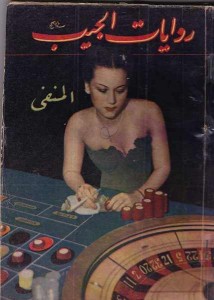
Pocket Novels: The Exile, J. Kessel, 1940. “A Novel of Human Untruths, about a Russian woman and her princesses, in exile, from the pen of the great French writer J. Kissel,” presumably the French novelist and journalist Joseph Kessel (1898-1979) August 20, 2014 | by Jonathan Guyer Cairo: the metal detector beeps. The security man wears a crisp white uniform. He nods and leans back in his chair. The lobby’s red oriental carpet, so worn it’s barely red, leads upstairs to the hotel tavern.