@ Galway Dance Days Festival 2015
March 27-29 2015
NUI Galway & locations in Galway
CONFLICTED BODIES
Call for Submissions
What is the impact on the body (and dance/performance) of living in conflict environments? What impact can dance/performance have in changing such circumstances? Art about, of and against conflict has always existed, but it is only recently that recognition has been given to the particular significance of movement, and dance, in foregrounding the body as the locus of instigation, experience and resolution of conflict.
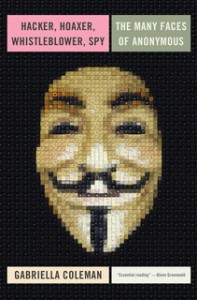
by Gabriella Coleman “Easily the best book on Anonymous.” —Julian Assange Here is the ultimate book on the worldwide movement of hackers, pranksters, and activists that operates under the non-name Anonymous, by the writer the Huffington Post says “knows all of Anonymous’ deepest, darkest secrets.” Half a dozen years ago, anthropologist Gabriella Coleman set out to study the rise of this global phenomenon just as some of its members were turning to political protest and dangerous disruption (before Anonymous shot to fame as a key player in the battles over WikiLeaks, the Arab Spring, and Occupy Wall Street).
Video recording of presentation by Marianne Maeckelbergh at the Prefiguration in Contemporary Activism Workshop, 4 December 2014, University of Manchester.
A CTIS/CIDRAL Workshop: 4 December 2014 Keynote Speaker: Marianne Maeckelbergh (Institute of Cultural Anthropology and Development Sociology, Leiden University, Netherlands; Co-founder of Global Uprisings)
Click here for programme and abstracts
Prefiguration, or ‘prefigurative politics’, involves experimenting with ways of enacting the principles being advocated by an activist group in the here and now, rather than at some future point when the conditions for the ‘ideal society’ have already been created, thus collapsing the traditional distinction between means and ends.
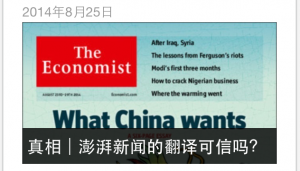
Netizens cry foul when a new Chinese media outlet selectively translates an Economist cover article. By BETHANY ALLEN-EBRAHIMIAN SEPTEMBER 3, 2014 On July 22, a glossy new Chinese media venture known as the Paper announced its launch to much fanfare. A subset of Shanghai's state-run Oriental Morning Post with outside investment estimated at $32 million, the Paper seems to be a venture into state-funded public service journalism. The timing is appropriate, coming as the influence of staid party mouthpieces has diminished while new media has flourished among China's increasingly internet-savvy populace.
Amelia Johns Social Inclusion, Volume 2, Issue 2, 2014, pp. 71-82 Abstract This paper reviews the current literature regarding Muslim young people’s practices with the aim of examining whether these practices open up new spaces of civic engagement and political participation. The paper focuses on the experiences of young Muslims living in western societies, where, since September 11, the ability to assert claims as citizens in the public arena has diminished.
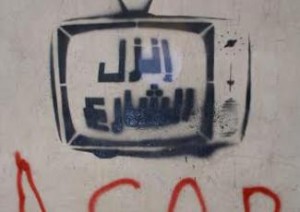
Graffiti in Cairo depicting a television with the text "Go down to the streets" Sep 05 2014 The 2011 revolutionary uprisings in the Middle East and North Africa abruptly captured global attention as the world was drawn breathlessly into the tumult with a profusion of media content, from Tweets to amateur video footage. Amidst the media blitz, analyses yielded two conflated and reactionary narratives of events. One contended that the popular protests of the so-called “Arab Spring” were wholly unexpected, a shocking diversion from the familiar politics of the Middle East in a seeming contravention of the reigning global political apathy at the turn of the millennium.
Screen grab of a Mosireen clip released in the wake of the 16 December Cabinet sit-in crackdown Mosireen, a media collective responsible for collating some of the most iconic videos of the Egyptian revolution, is now one of the most popular non-profit channels in the world after just four months of being on YouTube Bel Trew, Friday 20 Jan 2012 Mosireen, an Egyptian media collective of filmmakers and citizen journalists, has become the most viewed non-profit YouTube channel of all time in Egypt and the most viewed non-profit channel in the whole world this month.
by Guiomar Rovira Sancho, Universidad Autónoma Metropolitana, Mexico Guiomar Rovira Sancho, Universidad Autónoma Metropolitana, Carlos Lazo 218, int 2, Col. M.Hidalgo, cp. 14250, Mexico City, Mexico. Email: ondina_peraire@yahoo.com Published online before print July 15, 2014, doi: 10.1177/1354856514541743 ConvergenceJuly 15, 20141354856514541743 Abstract E-mail and Web pages made it possible to generate a space for global mobilization against the repression of the Zapatista indigenous rebels in the 1990s. The global justice movement that started in Seattle in 1999 extended global networks to organize action.