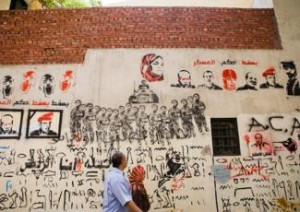
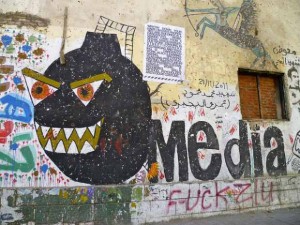
[Image from Hossam El-Hamalawy] by Hannah Elansary Sept 01 2014 The graffiti and street art of revolutionary Egypt have been researched many times over by now.Journalists and scholars have explored the phenomenon in its many aspects—as evolving visual text, as political rhetoric and as an act of protest in its own right. The claims about the protest street art and graffiti that have proliferated across public Egyptian walls since 2011 have been many, and include: the spread of revolutionary graffiti in Egypt was a sign and act of citizens reclaiming public space from the regime; street art worked to raise awareness and build community and solidarity among people; street art served as a tool by which citizens could (re)claim agency, assert identity, and create their own historical narratives.
A three-day conference to be held in Cairo, 6-8 March 2015 Funded by the Arts & Humanities Research Council, UK Organized by Mona Baker, Yasmin El Rifae, and Mada Masr http://globalizingdissent.wordpress.com Activists from various regions and countries connect with and influence one another through practices involving various types of translation, including video subtitling, written translation, and oral interpretation. The Egyptian Revolution and the activists and collectives who have worked to move it forward have been highly visible to other protest movements in large part through such practices.
Street art from Mohamed Mahmoud Street, Cairo. (Photo: Melody Patry/Index on Censorship) Graffiti artists face threats of violence, and the potential of jail time and fines under a proposed draft law
By Shahira Amin / 22 August, 2014
Before the January 2011 uprising, street art was little known in Egypt. Then came the revolution and with it, an outburst of creativity. With the fall of the authoritarian regime of Hosni Mubarak, Egyptian artists who had routinely faced censorship restrictions under his autocratic rule, felt a strong urge to break out of the confines of their studios and reclaim public spaces.
PRESS RELEASE
Madagascar's National Assembly has quietly adopted a cybercrime law that provides for prison sentences for anyone insulting or defaming a state representative online. Debated and passed without anyone knowing, the law has been the hot topic for journalists, bloggers and social network users ever since they learned of its existence. Any of them could be imprisoned if a court were to decide that something they posted on the Internet had slighted or maligned an official.
Special Thematic Section Journal of Social and Political Psychology Guest Editors: Jan Haaken, Flora Cornish, Catherine Campbell, Sharon Jackson, Liora Moskovitz The early 21st century proliferation of small-scale social movements in the Global North and South provides the context for this special section. 'Prefigurative politics' emerged in the 1970s as a term that expressed the ethos of creating alternative communities – fostering small-scale experiments in modes of living and working that realize in the present the values of an anticipated better society.
By launching a cyberwar. Anonymous — the faceless hacker collective best known for harrasing several American credit card companies, the Westboro Baptist Church and the Church of Scientology — has launched an aggressive assault on the Israeli government for their ongoing ground campaign in the Gaza Strip. And in true Anonymous fashion, they aren't hiding it — they're flaunting it. On July 20, Anonymous announced their plans to "
Dhanusha Gokulan / 4 August 2014 Ahmad Molham Makki's style of rapping perhaps has the distinction of being poetic and something that has a strong social message. From the clothes he wears, to the chains he wears and the attitude he sports, Ahmad Molham Makki, aka Molham Rebel, is every inch a rapper. But unlike several rappers, who are all about making it big with the syncopated lyrics, Makki’s style of rapping perhaps has the distinction of being poetic and something that has a strong social message.
Edited by Ethan Zuckerman and Lorrie LeJeune Available under a Creative Commons non-commercial license Ways in which activists and scholars around the world are using digital tools for social change Book Description Increasingly, activists around the world are using digital tools to seek social change. In this online resource, activists and scholars document the use of digital tools for social change in different corners of the world. Beginning with a set of geographically diverse case studies, this site will grow to include essays on the changing nature of digital activism, examining ways these global case studies inform and challenge existing understandings of social change.