Why Riot?, video by Mosireen Video Collect, 2013.
“The revolution is not a thing of the past, the revolution is still in process.” Philip Rizk stated as we began our discussion of his text “2011 is not 1968”, whereby he challenges the dominant narratives of the January 25th Revolution as a youth lead revolution. He argues that the radicalizing factor of the uprising was an underclass without leaders.
DevelopmentEducation.ie Action Projects AUTHOR DETAILS Colm Regan 80:20 Educating and Acting for a Better World - www.8020.ie The mural was co-ordinated by John Johnston of 80:20 (now with Goldsmith’s College, London) and Valarie Duffy (now with the National Youth Council of Ireland). PARTICIPANTS Young people 14+; over 9 schools and two youth organisations from East Belfast and the Republic of Ireland Phase 1 of the project was led by Alternatives in East Belfast and Presentation College, Bray, Co.
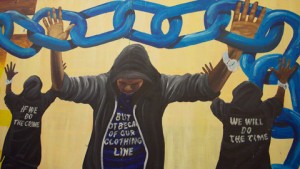
‘I Am Here’ mural detail. Pic: Laura Liszewski EAST LONDON LINES December 3, 2012 | Posted by: Laura Liszewski | Three scenes stand side by side, occupying a vibrantly painted mural. On the far left, a menacing officer’s mouth opens wide to expose a prisoner behind bars, on the far right hooded youths stand, pressed against walls and try to reach through blue chains, while in the middle of it all a peaceful man tends delicate flowers as white doves fly towards a yellow rising sun.
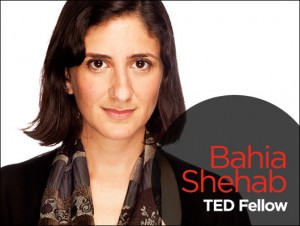
Published on May 21, 2013 Reviving calligraphy and shaping the future of script through her students, Bahia Shehab, Associate Professor of Practice in the Department of the Arts, works on the first ever encyclopedia of the Arabic script.
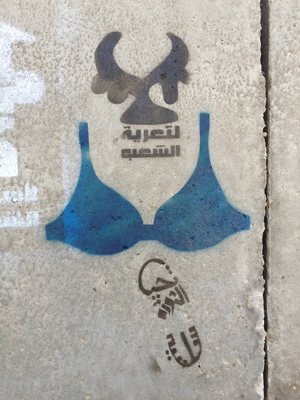
No to Stripping BY Nama Khalil 2 September 2014, Design and Violence From the curators: Using sexual violence to intimidate, crack down on dissent, or brutalize opposition is nothing new. Neither is graffiti—illicit drawings are older than Pompeii. However, such designs have taken on new life of late, paralleling an increased public and political focus on female sexuality. During the wave of disparate yet interconnected protests that made up the Arab Spring (2010–ongoing), graffiti emerged as an untamable form of grassroots resistance to such violence.
https://vimeo.com/89910610 24 March 2014, Louisiana Channel "Graffiti is like flowers. They are beautiful, but they don't live long." An interview with Lebanese-Egyptian street-artist Bahia Shehab about the role of art during the Arab spring: "You cannot resist ideas. They can travel into any mind." "I am a quiet person, I don't know how to scream", says Bahia Shehab. "My contribution to the revolution was to paint on the walls, was to be an artist.
Posted by: Karen Eng September 7, 2012 TED Blog When art historian and scholar of Arabic script Bahia Shehab was asked to create a piece commemorating the centenary of the first exhibition on Islamic art in Europe, little did she know that the Egyptian revolution would ultimately transform her into a street artist and activist with a powerful and subtle voice of protest. How did your work with the character for “no” begin?
By Bahia Shehab, Citysharing The streets of Cairo have become an open gallery to many artists wishing to express their views, dreams and hopes for a better Egypt. Artists are using the walls of the city to tell their stories, to lament the death of martyrs and to call for political and social change. Thus each painted wall acquires a life of its own, it no longer belongs to a building, a bridge or a street, but it has been recruited to serve a cause and to rally a group of people to support that cause.
Filmed June 2012 Subtitles available in 36 languages Art historian Bahia Shehab has long been fascinated with the Arabic script for ‘no.’ When revolution swept through Egypt in 2011, she began spraying the image in the streets saying no to dictators, no to military rule and no to violence.
Interactive transcriptInteractive transcript
TED Fellow Bahia Shehab sends an important message through her street art in Cairo: “You can crush the flowers, but you can’t delay spring.
Published on Mar 22, 2013 Egypt's January 25 revolution helped bring out the best in raw and potent urban arts, most of all in the graffiti scene in Cairo. This short video gives a brief glimpse into the always evolving street art scene that has gone from strength to strength and become a valuable component in the creative resistance to Egyptian authorities and establishment. Produced by: Soraya Morayef Directed and Edited by: Marwan Imam Music by: Ahmed Safi Footage courtesy of: Islam Momtaz Soraya Morayef Amir Nazeer Farah Saafan Ian Lee Rodina Mikhail Carmel Alyaa Delshad Featuring the works of: The Sad Panda Kareem Gouda Ganzeer Charles Akl Amr Gamal Ammar Abo Bakr Mohamed El Moshir Laila Magued Alaa Awad Zeft Amr Nazeer Hozny Iyad Oraby Aref and Hoda Ismail Ahmed El Masry Saiko Manio Ahmed Abdallah KIM Shaza Khaled Alia El Tayeb El Teneen Hossam Shukrallah Ziad Tarek Mariam Abou Ghazi Youssef Bagato Saif Roshdy Mostafa el Tourkhy And many others who remain anonymous