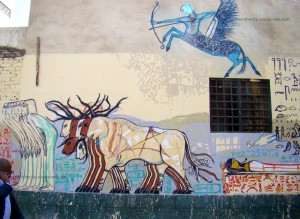
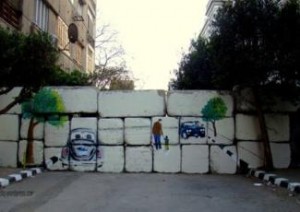
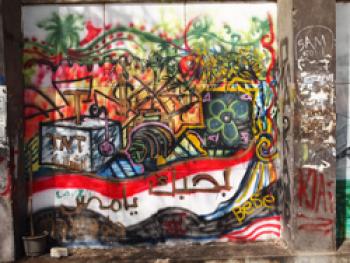
Mural by Alaa Awad Africaseen blog, 2nd April 2013 by Susan Phillips While Soraya Morayef identifies herself as a writer and journalist, I see her through a different lens, as an artist and archivist. Through her photo blog documenting the extraordinary explosion of street art in Egypt following the initial Tahrir Square protests of January 2011, Morayef has captured, framed, and contextualized a fleeting moment in Egypt's long, proud history of artistic and cultural expression.
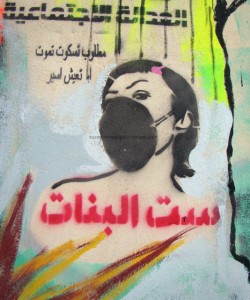
Sit El Banat, stencil tribute to the women who were beaten, dragged and stamped on by military forces in December 2011. Copyright Suzee in the City. 28 March 2013, africaisacountry.com Mickey Mouse is pulling apart a bomb: inside is the torso of George W. Bush, and they’re both looking perfectly happy about the whole thing. Soraya Morayef is taking a photo of the wall where these figures are painted, on a busy street in downtown Cairo, when a man walks up to her and asks her what the picture means.
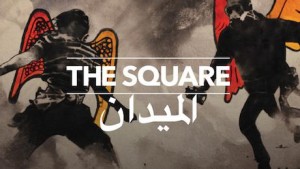
By Soraya Morayef Open Democracy, 25 March 2014 The author reviews the only documentary released to-date of the people's uprising in Egypt until the fall of Mohamed Morsi on 3 July 2013. There is no such thing as a comprehensive narrative of the Egyptian revolution. Anyone attempting such a thing will most likely fail, as the complex evolution of a people’s uprising to where Egypt is today cannot be summarised in one story, let alone a 108-minute film.
By Soraya Morayef Open Democracy, 13 November 2013 Many disregard the recurrent stories of prison deaths, police torture and rape because - on the other hand – Egypt's streets are empty after curfew and the walls are freshly painted; surely a clear indication that the state has succeeded in restoring security and defeating terrorism. On Tuesday November 5, Egypt’s Minister of Local Development, Adel Labib, announced a new law criminalizing graffiti with a maximum jail sentence of four years and a fine of 100,000LE.
[A mural on Sheikh Rihan Street's wall. Image from the author.]By Soraya Morayef Jadaliyya, 22 May 2012 Around the corner from Tahrir Square, the heart of Egypt’s eighteen-day uprising, Mohamed Mahmud Street bears the scars of a turbulent political year in Egypt. The once-bustling street off of Tahrir Square has seen its share of violent battlefields--beginning with 28 January 2011 and ending with the February 2012 clashes following the Port Said massacre.
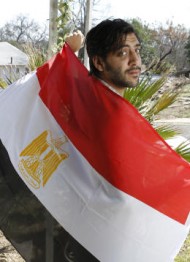
Sherief Gaber As Interviewed by Elizah Flores, March 30, 2011 Whatever connection I had with Egypt was just screaming at me that I had to go. Introductory Profile: About Sherief Gaber
Sherief Gaber is a twenty-six year-old graduate student at the University of Texas studying law and urban planning. He grew up in Memphis and went to college in Saint Louis. His parents came to America from Egypt shortly before he was born.
Published on February 28, 2011 at 12:00 am By Allie Kolechta A UT graduate student stood with protesters in downtown Cairo as they barricaded themselves against military attacks and fought for a revolution in the midst of former President Hosni Mubarak’s resignation. Law and urban planning graduate student Sherief Gaber flew straight into Cairo on Jan. 30 to join the protests in Tahrir Square before Mubarak stepped down from the Egyptian presidency.
by Middle East Studies Center at AUC Jadaliyya, 24 February 2014 On 19 February 2014, the Middle East Studies Center at the American University in Cairo hosted Sherief Gaber, a member of the Mosireen film collective and researcher in housing rights and community development, for a lecture titled “Mosireen and the Battle for Political Memory.’’ Gaber discussed the mission and activities of the Mosireen film collective. Mosireen, or ”We are determined,” is a non-profit media collective dedicated to preserving and sharing images and video documenting the extraordinary events during and since the January 2011 Egyptian uprising.
6 June 2013, sicherheitspolitik-blog Sherief Gaber is a researcher in issues related to the right to the city and socially just cities and a member of the Mosireen Independent Media Collective in Cairo. Mosireen documented the protests during the ‚Egyptian revolution‘. At a conference in Berlin you said the internet’s influence on the protests and revolution in Egypt was overrated. How would you describe its impact and why do you think others exaggerate it?