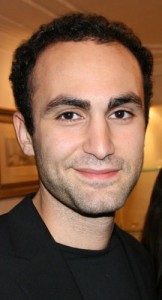
Channel 4 News, 14 August 2013 Actor and director Khalid Abdalla gives his personal response to the deadly violence gripping Egypt following operations to clear pro-Morsi camps in Cairo. I'm disgusted by the blood, and resisting falling prey to a polarised narrative. I don't believe the sit-in should have been cleared, but I'm against what the sit-in stands for. I hold both the army and the Brotherhood responsible for the situation we're in - on so many levels - and unfortunately it's the narratives they are peddling, in blood, in actions and in words, that are currently defining how things are framed, internally and externally.
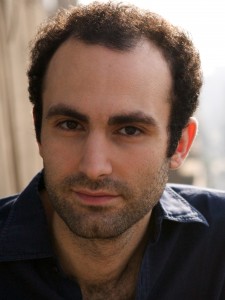
16 August 2013 Both the Egyptian military and the Muslim Brotherhood are "wrong" and "fundamentally fascist organisations", an Egyptian actor and activist has claimed. Khalid Abdalla, known to western audiences for his roles in The Kite Runner and United 93, told the BBC's Mishal Husain the he "rejected the binaries" being presented - the choice between the two organisations - saying the future solution had to be an inclusive one, with everyone represented.
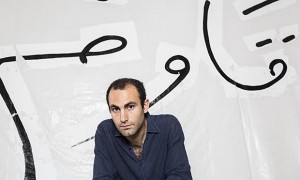
Khalid Abdalla stands in front of a painting of the Arabic word for "Resist" in Cairo. Photograph: David Degner David Degner/David Degner The British-born actor found success in United 93 and The Kite Runner, but has spent much of the last three years camped out in Tahrir Square Andrew Anthony
Sunday 3 November 2013
When actor and political activist Khalid Abdalla was a young schoolboy, a teacher set his class the task of writing their own obituaries.
[Untitled. Illustration by Salma El Tarzi]by Wiam El-Tamami Jadaliyya, 30 July 2013 We were on the edge of Tahrir Square on Wednesday 3 July when the army made its announcement. The square burst into jubilation. A member of our team checked his smartphone. He shouted over the din of drumbeats and squealing vuvuzelas: “Morsi's gone. They've appointed the head of the constitutional court in his place and suspended the elections.” We watched the celebrations.
Photo by Joseph Robertson Mansoura Ez Eldin & Wiam El-Tamami
Granta, 28 September 2011
Last night Wiam El-Tamami was announced as the winner of Harvill Secker’s second annual Young Translators’ Prize in association with Foyles. We are delighted to support this venture by publishing the winning story, below, with an interview with Wiam by Online Editor Ted Hodgkinson. The judges this year were author Penelope Lively, journalist Maya Jaggi, translator Anthony Calderbank and Harvill Secker editor Briony Everroad.
Wiam El-Tamami Granta, 6 December 2011 In the first of a two-part diary, Wiam El-Tamami writes from Cairo about the violence that continues to engulf Egypt. Photo by Gigi Ibrahim. Monday 28 November I woke up in a rage about the elections. A violent, sputtering rage, bordering on revulsion. I felt like a dog that had been fed a teething toy to stop his howling about a wide-open wound. I couldn’t get the sign out of my mind, raised by an old man in Tahrir: ‘If Tantawi can’t accept my sowt in a vast square, will he accept it in a ballot box?
Wiam El-Tamami Granta, 7 December 2011 The second and last installment of Wiam El-Tamami’s diary of the ongoing turmoil in Egypt. Read the first part here. Monday 21 November On the metro home, a man (one of State Security’s many informants?) was swearing that he’d just been at the midan and that there was nothing going on, that it was all lies. The people sitting around shouted him down, saying they’d seen the videos with their own eyes, police beating and shooting, setting the square on fire, dragging a dead man into a rubbish heap.
Wiam El-Tamami Granta, 31 October 2013 I can only say, there we have been: but I cannot say where. – T. S. Eliot, ‘Burnt Norton’ I can tell you about my sister’s balcony, overhung with old trees that quiver with birdsong in the morning, a rare treat in this city. I can tell you about her sofa, lump by lump; about the dining table chair she sat in most days to work, an orthopedic cushion strapped to its back.
Tuesday, April 14, 2015 - 13:42 By: Mai Shams El-Din, Mada Masr
اقرأها بالعربية This is an introduction to a series of interviews by Mada Masr with human rights workers in Egypt that attempts to situate the struggle for rights within the context of a larger movement and the contest over political space. Many human rights workers have felt targeted by the government after a warning was issued in state newspapers last summer requesting that all civil society groups register in accordance with the NGO Law, or else incur legal repercussions.
Mosireen Subtitling Workshop, 30 April 2014, held at ADEF (Arab Digital Expression Foundation), Cairo
This workshop was held for activist subtitlers, particularly those associated with Mosireen, and coordinated by Katharine Halls, Salma El-Tarzi and Danya Nada. It was delivered by Dr Luis Perez-Gonzalez and introduced by Professor Mona Baker, both from the University of Manchester, UK.
Download the Powerpoint