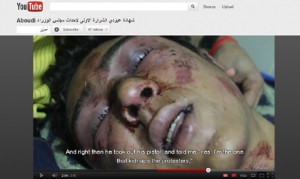
Screen grab of a Mosireen clip released in the wake of the 16 December Cabinet sit-in crackdown Mosireen, a media collective responsible for collating some of the most iconic videos of the Egyptian revolution, is now one of the most popular non-profit channels in the world after just four months of being on YouTube Bel Trew, Friday 20 Jan 2012 Mosireen, an Egyptian media collective of filmmakers and citizen journalists, has become the most viewed non-profit YouTube channel of all time in Egypt and the most viewed non-profit channel in the whole world this month.
Screen grab of a Mosireen clip released in the wake of the 16 December Cabinet sit-in crackdown Mosireen, a media collective responsible for collating some of the most iconic videos of the Egyptian revolution, is now one of the most popular non-profit channels in the world after just four months of being on YouTube Bel Trew, Friday 20 Jan 2012 Mosireen, an Egyptian media collective of filmmakers and citizen journalists, has become the most viewed non-profit YouTube channel of all time in Egypt and the most viewed non-profit channel in the whole world this month.
By Amira Howeidy | SEP 02, 2014 Within four months of the military’s ouster of Mohamed Morsi, one of the icons of liberalism serving in the new cabinet, Ziad Bahaa-Eldin, admitted to CNN that those who called for political reconciliation, like himself, were alienated by the political mood, where the very concept of reconciliation has become “a dirty word” in Egypt.
Yet when Morsi was forced out on July 3 reconciliation was part of the official discourse.
Yara Sallam Posted: 09/02/2014 Dalia Abd El-Hameed Gender and women's rights officer for the Egyptian Initiative for Personal Rights (EIPR). Yara Sallam, the transitional justice officer at the Egyptian Initiative for Personal Rights, was arrested on June 21 a block away from a Cairo protest march against a draconian law that effectively bans demonstrations. Under the law, in effect since November 2013, thousands of people have suffered from arrest and detention.
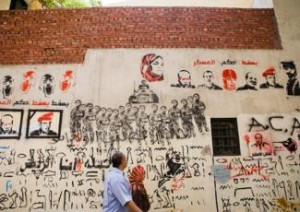
[Image from Hossam El-Hamalawy] by Hannah Elansary Sept 01 2014 The graffiti and street art of revolutionary Egypt have been researched many times over by now.Journalists and scholars have explored the phenomenon in its many aspects—as evolving visual text, as political rhetoric and as an act of protest in its own right. The claims about the protest street art and graffiti that have proliferated across public Egyptian walls since 2011 have been many, and include: the spread of revolutionary graffiti in Egypt was a sign and act of citizens reclaiming public space from the regime; street art worked to raise awareness and build community and solidarity among people; street art served as a tool by which citizens could (re)claim agency, assert identity, and create their own historical narratives.
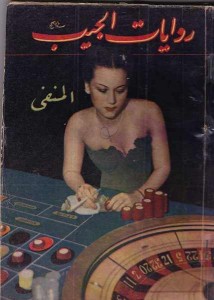
Pocket Novels: The Exile, J. Kessel, 1940. “A Novel of Human Untruths, about a Russian woman and her princesses, in exile, from the pen of the great French writer J. Kissel,” presumably the French novelist and journalist Joseph Kessel (1898-1979) August 20, 2014 | by Jonathan Guyer Cairo: the metal detector beeps. The security man wears a crisp white uniform. He nods and leans back in his chair. The lobby’s red oriental carpet, so worn it’s barely red, leads upstairs to the hotel tavern.
Pocket Novels: The Exile, J. Kessel, 1940. “A Novel of Human Untruths, about a Russian woman and her princesses, in exile, from the pen of the great French writer J. Kissel,” presumably the French novelist and journalist Joseph Kessel (1898-1979) August 20, 2014 | by Jonathan Guyer Cairo: the metal detector beeps. The security man wears a crisp white uniform. He nods and leans back in his chair. The lobby’s red oriental carpet, so worn it’s barely red, leads upstairs to the hotel tavern.
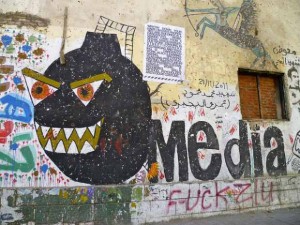
Street art from Mohamed Mahmoud Street, Cairo. (Photo: Melody Patry/Index on Censorship) Graffiti artists face threats of violence, and the potential of jail time and fines under a proposed draft law
By Shahira Amin / 22 August, 2014
Before the January 2011 uprising, street art was little known in Egypt. Then came the revolution and with it, an outburst of creativity. With the fall of the authoritarian regime of Hosni Mubarak, Egyptian artists who had routinely faced censorship restrictions under his autocratic rule, felt a strong urge to break out of the confines of their studios and reclaim public spaces.
Street art from Mohamed Mahmoud Street, Cairo. (Photo: Melody Patry/Index on Censorship) Graffiti artists face threats of violence, and the potential of jail time and fines under a proposed draft law
By Shahira Amin / 22 August, 2014
Before the January 2011 uprising, street art was little known in Egypt. Then came the revolution and with it, an outburst of creativity. With the fall of the authoritarian regime of Hosni Mubarak, Egyptian artists who had routinely faced censorship restrictions under his autocratic rule, felt a strong urge to break out of the confines of their studios and reclaim public spaces.
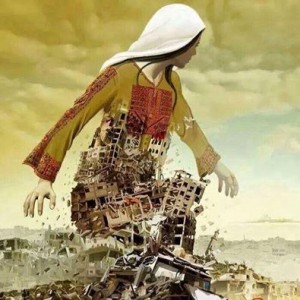
Gaza and Palestine, by Ema Abu Shtayyeh Antoun Issa Posted: 08/25/2014 The resumption of fighting between Israel and Hamas can be largely attributed to Egypt's failure to broker a fair, enduring cease-fire. Egypt's cease-fire proposal, as outlined in 11 points, was effectively a call for a return to the status quo: a besieged Gaza Strip with token, unspecified assistance to help it rebuild - the third reconstruction Gaza will have to undergo in less than seven years.