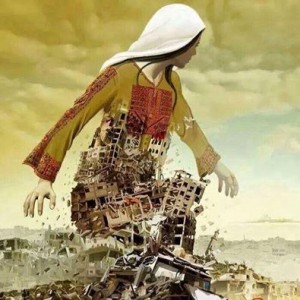
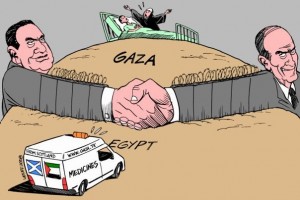
Gaza and Palestine, by Ema Abu Shtayyeh Antoun Issa Posted: 08/25/2014 The resumption of fighting between Israel and Hamas can be largely attributed to Egypt's failure to broker a fair, enduring cease-fire. Egypt's cease-fire proposal, as outlined in 11 points, was effectively a call for a return to the status quo: a besieged Gaza Strip with token, unspecified assistance to help it rebuild - the third reconstruction Gaza will have to undergo in less than seven years.
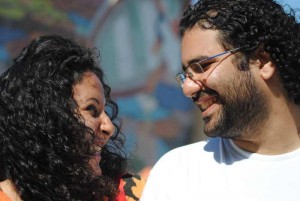
Alaa Abd El Fattah with his wife and intellectual partner, Manal Hassan. Photo by Lilian Wagdy via Wikimedia Commons (CC BY 2.0) 22 August 2014 Written by Nani Jansen and Adrian Plevin. After imprisoned Egyptian blogger and human rights defender Alaa Abd El Fattah went on hunger strike this past Monday, the Media Legal Defence Initiative (MLDI) and Electronic Frontier Foundation (EFF) petitioned the UN Working Group on Arbitrary Detention (UNWGAD) to take all necessary steps to secure Abd El Fattah’s immediate release.
By Omar Robert Hamilton Wednesday, August 20, 2014 - 07:33 After three spells of imprisonment since the start of the revolution, Alaa Abd El Fattah has declared that he is starting a hunger strike. Alaa is one of 25 people who were sentenced to 15 years in prison for attending/organizing a protest in November. A protest in which a policeman who was filmed strangling a young woman fell over and lost his walkie talkie.
ARGUMENT As Israel and the Palestinians struggle to reach yet another cease-fire, the mediators in Cairo are making the conflict worse -- and empowering radicals in the process. BY MICHELE DUNNE , NATHAN J. BROWN AUGUST 18, 2014 As negotiations on a lasting cease-fire in Gaza grind on in Cairo, it's not only the animosity between Israel and Hamas that is complicating the talks -- it's also Egypt's role as mediator.
ARGUMENT As Israel and the Palestinians struggle to reach yet another cease-fire, the mediators in Cairo are making the conflict worse -- and empowering radicals in the process. BY MICHELE DUNNE , NATHAN J. BROWN AUGUST 18, 2014 As negotiations on a lasting cease-fire in Gaza grind on in Cairo, it's not only the animosity between Israel and Hamas that is complicating the talks -- it's also Egypt's role as mediator.
by Philip Rizk Tuesday, January 28, 2014 - 17:42 Editor’s note: If the Palestinian struggle has taught us one thing, it is not to forget, to remember, to retell our stories of resistance over and over again. And it might be that Egypt’s revolutionary voices have hit a point, where remembering, revising and retelling is at the epicenter of their resistance. In this spirit, we asked Philip Rizk to use this space to retell his story of the revolution, as he wrote it in 2012.
By Omar Robert Hamilton Tuesday, December 24, 2013 - 01:14 The light is different in Zeinhom. The narrow street, arching trees and gentle slope of one of Cairo’s only hills combine to soften the bright, direct light that casts the city in her familiar monochrome. The light comes at you at an angle. Maybe it’s the hill. Or maybe it’s because I only go to Zeinhom early in the morning, to go to the city morgue.
Saturday, August 17, 2013 - 22:26 by Omar Robert Hamilton I sit, for the 12th hour now, alone and struggling for what to do. For the first time since I got on a plane for Egypt on January 29, 2011, I am at a loss. Worse days than today lie ahead of us. We thought we could change the world. We know now that that feeling was not unique to us, that every revolutionary moment courses with the pulse of a manifest destiny.
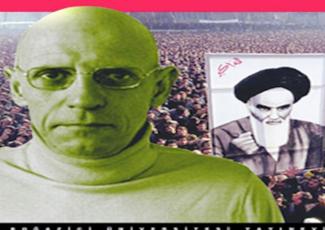
[Cover of the Turkish translation of "Foucault and the Iranian Revolution." Image provided by author.] by Anthony Alessandrini [This article is the final in a three-part Jadaliyya series that looks at Foucault's work in relationship to the legacy of French colonialism in North Africa. Read the first and second installments here: "The Dangers of Liberalism: Foucault and Postcoloniality in France" by Diren Valayden and "Justifications of Power": Neoliberalism and the Role of Empire by Muriam Haleh Davis.
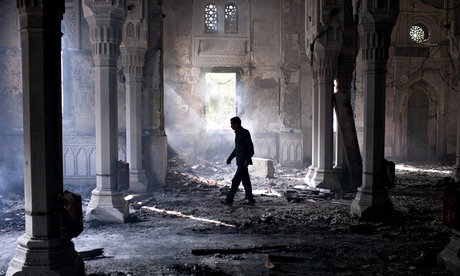
The killing of 817 protesters last August was this week judged a crime against humanity equal to, or worse, than Tiananmen Square. But feelings on the ground are mixed Destruction … the Rabaa al-Adawiya mosque, the morning after the massacre. Photograph: Ahmed Hayman/EPA Patrick Kingsley The Guardian, Saturday 16 August 2014
"To this day, I can't believe it happened. I reached a point where I couldn't talk to anyone. I couldn't talk to my family.