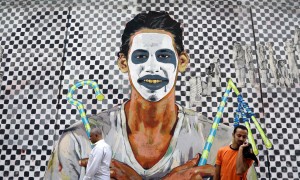
Egyptians walk past graffiti with modern and pharaonic motifs in Mohammed Mahmoud Street near Tahrir Square, Cairo in 2014. The famous wall is being systematically knocked down. Photograph: Hassan Ammar/AP The struggle behind Cairo's revolutionary graffiti wall The graffiti murals that sprang up on the walls of Cairo were a spontaneous reaction to Egypt’s revolution. But, despite their cultural importance, they’re being demolished in an attempt to clean up the city .
Subtitling in the Egyptian Revolution DOI: 10.1080/13556509.2016.1148438 (link to prepublication version at end of post)Mona Baker, The Translator, Volume 22, Number 1, 2016, pages 1-21 Abstract The idea of prefiguration is widely assumed to derive from anarchist discourse; it involves experimenting with currently available means in such a way that they come to mirror or actualise the political ideals that inform a movement, thus collapsing the traditional distinction between means and ends.
[Egyptian medical doctors gather in front of the Medical Doctors Syndicate building in February 2016 to protest police abuse against medical professionals. Photo from elsfha.com]by Abdelrahman Mansour and Mohamed Aboelgheit Jadaliyya, 14 May 2016 Egyptians occupying streets, blocking traffic, and chanting patriotic slogans: Contrary to conventional wisdom, these images became part of Egypt’s contemporary political arena well before the January 2011 Revolution. We saw them on multiple occasions in 2006, 2008, and even in 2010, when Egypt’s national football team won the Africa Cup of Nations.
[Giulio Regeniby Omar Robert HamiltonBy Omar Robert Hamilton Jadaliyya, 16 February 2016 Multiple fractures, cigarette burns, abrasions, fingernails forcibly removed and every finger bro-ken, dozens of lacerations all over the body, on the soles of feet and ears all ending in a broken neck and suffocation. Giulio’s body was found semi-naked by the side of the road. The marks of Egypt’s security services are instantly recognizable. No one has any doubt about who killed Giulio Regeni.
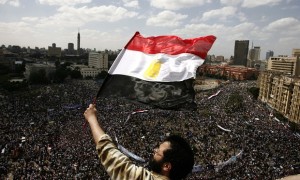
Tens of thousands of Egyptians demonstrate in Cairo’s Tahrir Square in January 2011. Photograph: Misam Saleh/AFP/Getty Images Omar Robert Hamilton The Guardian, Monday 25 January 2016 I didn’t take my camera out with me the night Hosni Mubarak was overthrown. I stood in Tahrir Square among tens of thousands of Egyptians and told myself I would enjoy the moment, I would not divide myself from the night’s magical reality with a lens.
Egyptian pupils play at a school near Cairo Photograph: Hong Wu/Getty Images Egypt may today look like a tragic example of why mass protest is doomed, but the turmoil of the five years since Tahrir Square has unleashed a will for change and a resistance to power among ordinary citizens that could yet transform the country, and maybe the world Jack Shenker
The Guardian, Saturday 16 January 2016
The video is shot from a balcony, and its style is familiar.
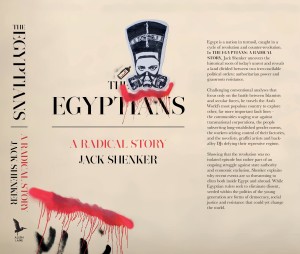
By Jack Shenker A book exploring Egypt's revolution and counter-revolution from below, published by Allen Lane / Penguin - Available now to pre-order - Egypt: 2011-16 “Egypt’s revolutionary turmoil has been misunderstood, and a great deal of that misunderstanding has been deliberate.” Five years on from the start of Egypt’s revolution, and counter-revolution, ‘The Egyptians: A Radical Story’ interrogates the country’s turmoil from below – and argues that its struggles are intimately enmeshed with global patterns of oppression and resistance which stretch well beyond Egypt’s borders.
by Anthony Alessandrini Jadaliyya, 19 November 2015 [Alisa Lebow, a filmmaker and film scholar who teaches at the University of Sussex, is the Creator/Director/ Producer/Writer of Filming Revolution, an interactive data-base documentary archive about independent and documentary filmmaking in Egypt since the revolution, which was launched in October 2015.]
Anthony Alessandrini (AA): Could you talk a bit about what made you put together this project: when did you decide to set Filming Revolution in motion, how did the specific form of the project come together, and how did you go about choosing filmmakers, archivists, activists, and artists to interview?
12 October 2015, Mada Masr
By Jonathan Guyer
“All comics are political,” wrote Allen Douglas and Fedwa Malti-Douglas in their seminal 1994 study Arab Comic Strips. But whether for children or adults, the forms of political expression in comics are never straightforward.
Translated editions of Superman project cultural imperialism as well as the human need for heroes and villains. A comic advertising Stella beer from a 1957 newspaper presents a snapshot of Cairo’s cosmopolitan past.
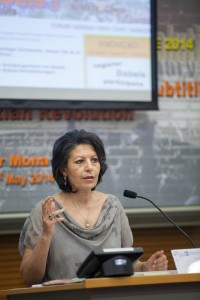
Professor Martha Cheung Memorial Lecture, May 2014, Hong Kong Baptist University Mona Baker, Centre for Translation & Intercultural Studies, University of Manchester The idea of prefiguration originally derived from anarchist discourse; it involves experimenting with currently available means in such a way that they come to mirror or actualize the political ideals that inform a movement, thus collapsing the traditional distinction between means and ends. Practically all the literature on prefiguration has so far focused on structural, organizational and interactional issues.