By Ahmed Refaat Mada Masr, 15 March 2015 I first heard Mona Baker two months ago in a workshop organized by the Imaginary School Program at Beirut, the art space not the city. It was called: “Prefigurative politics and creative subtitling.”
During the three-hour event, Baker briefly summed up what she discusses more elaborately in her research project, “Translating the Egyptian Revolution,” which “examines the language-based practices that allow Egyptian protesters to contest dominant narratives of the revolution and, importantly, to connect with, influence and learn from global movements of protest.
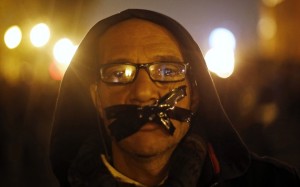
An anti-Mubarak protester in Tahrir Square, in November 2014 (Amr Abdallah Dalsh/Reuters) THANASSIS CAMBANIS, JAN 16 2015 CAIRO—Four years after the revolution he helped lead, Basem Kamel has noticeably scaled back his ambitions. The regime he and his friends thought they overthrew after storming Tahrir Square has returned. In the face of relentless pressure and violence from the authorities, most of the revolutionary movements have been sidelined or snuffed out. Egypt’s new strongman, President Abdel Fattah el-Sisi, has injected new zeal and energy into the military establishment.
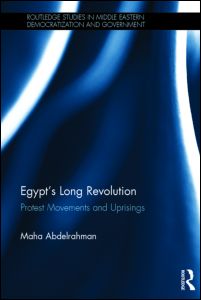
By Maha Abdelrahman Routledge – 2015 – 170 pages
Series: Routledge Studies in Middle Eastern Democratization and Government
The millions of Egyptians who returned to the heart of Cairo and Egypt’s other major cities for 18 days until the eventual toppling of the Mubarak regime were orderly without an organisation, inspired without a leader, and single-minded without one guiding political ideology. This book examines the decade long of protest movements which created the context for the January 2011 mass uprising.
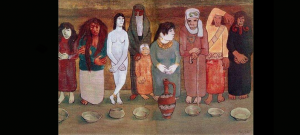
Abdul Hadi El Gazzar’s - The Theatre of Life and Hunger (1952) (Courtesy of The AMCA Project's Pinterest Account) By: Sultan Al Qassemi 31 October 2014
Egyptian artists were deeply involved in spearheading, capturing, and influencing the January 2011 uprising. In fact, the artistic community lost one of its own when 32-year-old Ahmed Bassiouny died in the early days of the uprising while taking part in the protests. For four days, the contemporary digital artist and experimental musician documented the protests in videos, which were then posted online each evening.
Sally Toma Monday, October 13, 2014 A nurse and her staff have tamed the men in a mental health ward into becoming compliant patients. They spend their days and nights in a medicine-induced state of fogginess that prevents them from rebelling against the petty rules and regulations that govern the ward. A smug guy believing he is free arrived as a patient and is not willing to comply — especially when he recognizes that the nurse's goal was to rule the ward.
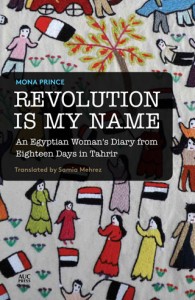
Mona Prince Translated by Samia Mehrez English edition Sep 2014 200 pp. Paperback$16.95 /LE90 ISBN 978 977 416 669 3 “For thinking about how the collective memory of revolution is being created right now, even as the revolution regains its steam, there is no better place to start than with Mona Prince’s remarkable memoir of the 25 January Uprising. . . . Revolution is My Name tells the story of revolution as it unfolds over eighteen days.
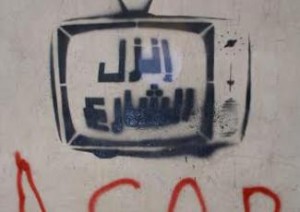
Graffiti in Cairo depicting a television with the text "Go down to the streets" Sep 05 2014 The 2011 revolutionary uprisings in the Middle East and North Africa abruptly captured global attention as the world was drawn breathlessly into the tumult with a profusion of media content, from Tweets to amateur video footage. Amidst the media blitz, analyses yielded two conflated and reactionary narratives of events. One contended that the popular protests of the so-called “Arab Spring” were wholly unexpected, a shocking diversion from the familiar politics of the Middle East in a seeming contravention of the reigning global political apathy at the turn of the millennium.
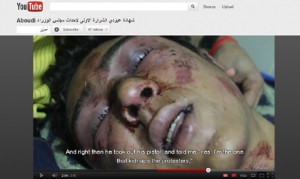
Screen grab of a Mosireen clip released in the wake of the 16 December Cabinet sit-in crackdown Mosireen, a media collective responsible for collating some of the most iconic videos of the Egyptian revolution, is now one of the most popular non-profit channels in the world after just four months of being on YouTube Bel Trew, Friday 20 Jan 2012 Mosireen, an Egyptian media collective of filmmakers and citizen journalists, has become the most viewed non-profit YouTube channel of all time in Egypt and the most viewed non-profit channel in the whole world this month.
By Amira Howeidy | SEP 02, 2014 Within four months of the military’s ouster of Mohamed Morsi, one of the icons of liberalism serving in the new cabinet, Ziad Bahaa-Eldin, admitted to CNN that those who called for political reconciliation, like himself, were alienated by the political mood, where the very concept of reconciliation has become “a dirty word” in Egypt.
Yet when Morsi was forced out on July 3 reconciliation was part of the official discourse.
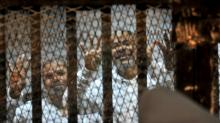
Yara Sallam Posted: 09/02/2014 Dalia Abd El-Hameed Gender and women's rights officer for the Egyptian Initiative for Personal Rights (EIPR). Yara Sallam, the transitional justice officer at the Egyptian Initiative for Personal Rights, was arrested on June 21 a block away from a Cairo protest march against a draconian law that effectively bans demonstrations. Under the law, in effect since November 2013, thousands of people have suffered from arrest and detention.