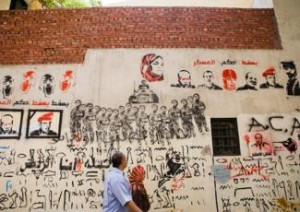
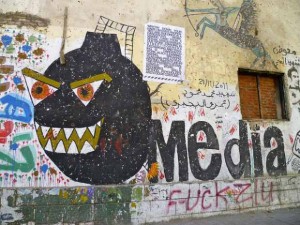
[Image from Hossam El-Hamalawy] by Hannah Elansary Sept 01 2014 The graffiti and street art of revolutionary Egypt have been researched many times over by now.Journalists and scholars have explored the phenomenon in its many aspects—as evolving visual text, as political rhetoric and as an act of protest in its own right. The claims about the protest street art and graffiti that have proliferated across public Egyptian walls since 2011 have been many, and include: the spread of revolutionary graffiti in Egypt was a sign and act of citizens reclaiming public space from the regime; street art worked to raise awareness and build community and solidarity among people; street art served as a tool by which citizens could (re)claim agency, assert identity, and create their own historical narratives.
A three-day conference to be held in Cairo, 6-8 March 2015 Funded by the Arts & Humanities Research Council, UK Organized by Mona Baker, Yasmin El Rifae, and Mada Masr http://globalizingdissent.wordpress.com Activists from various regions and countries connect with and influence one another through practices involving various types of translation, including video subtitling, written translation, and oral interpretation. The Egyptian Revolution and the activists and collectives who have worked to move it forward have been highly visible to other protest movements in large part through such practices.
Street art from Mohamed Mahmoud Street, Cairo. (Photo: Melody Patry/Index on Censorship) Graffiti artists face threats of violence, and the potential of jail time and fines under a proposed draft law
By Shahira Amin / 22 August, 2014
Before the January 2011 uprising, street art was little known in Egypt. Then came the revolution and with it, an outburst of creativity. With the fall of the authoritarian regime of Hosni Mubarak, Egyptian artists who had routinely faced censorship restrictions under his autocratic rule, felt a strong urge to break out of the confines of their studios and reclaim public spaces.
by Philip Rizk Tuesday, January 28, 2014 - 17:42 Editor’s note: If the Palestinian struggle has taught us one thing, it is not to forget, to remember, to retell our stories of resistance over and over again. And it might be that Egypt’s revolutionary voices have hit a point, where remembering, revising and retelling is at the epicenter of their resistance. In this spirit, we asked Philip Rizk to use this space to retell his story of the revolution, as he wrote it in 2012.
Saturday, August 17, 2013 - 22:26 by Omar Robert Hamilton I sit, for the 12th hour now, alone and struggling for what to do. For the first time since I got on a plane for Egypt on January 29, 2011, I am at a loss. Worse days than today lie ahead of us. We thought we could change the world. We know now that that feeling was not unique to us, that every revolutionary moment courses with the pulse of a manifest destiny.
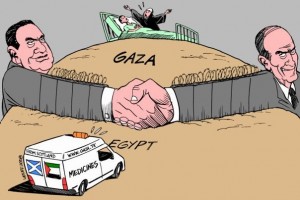
Posted by Baheyya 12 Aug 2014 01:28 PM PDT In the old days, when the Israeli military bombed and shelled Palestinians and sought to destroy their society, Hosni Mubarak used a well-worn formula, fully abetting Israeli actions while uttering pro-Palestine platitudes. Occasionally, when huge protests rocked the streets, he green-lighted theatrical gestures such as his wife heading a relief convoy to Gaza in 2002, and his son fronting a delegation to Beirut when Israel bombed Lebanon in 2006.