University of Liege, 7-9 May 2015 The words ‘translation’ and ‘politics’ are so frequently used in a metaphorical sense that it can be safely claimed both that everything depends on translation and that everything is involved in politics. It is clear, however, that from the beginning the two fields, as indeed language and power, are closely related. Translation is about understanding the other and being understood, or better about conveying a message which will often be reshaped to fit a purpose, whether it be marketing, negotiations, projected expectations of a target audience, when not straightforward propaganda.
Maastricht-Łódź Duo Colloquium Organisation The overall organisation of the International Maastricht-Łódź Duo Colloquiums is in the hands of the Maastricht School of Translation and Interpreting of Zuyd University of Applied Sciences (The Netherlands) and the Department of Translation Studies of the Institute of English Studies of the University of Łódź (Poland). The founders of the Maastricht-Łódź Duo Colloquiums are Dr. Marcel Thelen and Prof. Ordinarius Dr. Habil. Barbara Lewandowska-Tomaszcyk , respectively.
Location: Qatar National Convention Center, Doha, Qatar
Deadline for proposals: October 30th, 2014 Conference dates: March 23rd – 24th, 2015
Conference is organized by: Translation and Interpreting Institute (TII) “Beyond Fault Lines: Translating ‘the Gulf’” is the sixth in a series of annual international conferences that aim to create a Gulf-based platform for discussing issues related to translation. It will be held from March 23 to March 24, 2015 at Qatar National Convention Center (QNCC), Qatar.
POETRY/TRANSLATION/FILM – POÉSIE/TRADUCTION/FILM PoeTransFi 18-19 June 2015 EMMA, Paul Valéry University, Montpellier, France Please click HERE to download the CFP in PDF format. Scroll down for French version. The aim of this conference, which could also be entitled “The film as poem, the poem as film: A spectrum of translations”, is to revisit the inter-relations between poetry and film, envisaged under the angle of translation, in a broad sense of the term.
The Temporary Center for Translation is a site for pedagogical exchange founded on the importance of translation as a mode for thinking, making, and doing.
Every translation sets into play distinct vocabularies and systems of meaning—linguistic and otherwise—and it is in these encounters that priorities and positions are negotiated. While fidelity to an original work or idea is paramount in some theories of translation, the Center questions what exactly constitutes a likeness.
First Forlì International Workshop Department of Interpreting and Translation, University of Bologna Forlì, Italy, 7-8 May 2015 More than 15 years have passed since the late Miriam Shlesinger called upon the Interpreting Studies community to embrace corpus-based methodologies (Shlesinger 1998). Corpus-based methodologies enable researchers to collect empirical data in quantities large enough to make reliable generalizations about interpreter performance (as opposed to studies based on anecdotal evidence); moreover, they also make it possible to analyse relevant phenomena on greater data sets than is usually the case when "
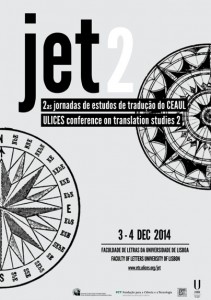
2nd ULICES Conference on Translation Studies – JET2
Venue: Faculty of Letters, University of Lisbon
Date: 3-4 December 2014
Keynote Speakers Abram De Swaan, University of Amsterdam, The Netherlands
Stefania Taviano, University of Messina, Italy
Call For Papers The rise of English as an international world language has had a dramatic effect on the practice of translation in all domains.
Innovation Paths in Translation and Intercultural Studies Call for Presentations
(papers, roundtables, workshops, “rapid fire” PhD presentations, and posters)
Deadline: 10th of September 2014
Following successful conferences in Seoul (2004), Cape Town (2006), Melbourne (2009) and Belfast (2012), IATIS is delighted to announce its call for panel, paper, roundtable, workshop, “rapid fire” PhD presentations and poster proposals for its fifth conference, which will be held at Universidade Federal de Minas Gerais (UFMG), Brazil, from 7th to 10th July 2015.
A three-day conference to be held in Cairo, 6-8 March 2015 Funded by the Arts & Humanities Research Council, UK Organized by Mona Baker, Yasmin El Rifae, and Mada Masr http://globalizingdissent.wordpress.com Activists from various regions and countries connect with and influence one another through practices involving various types of translation, including video subtitling, written translation, and oral interpretation. The Egyptian Revolution and the activists and collectives who have worked to move it forward have been highly visible to other protest movements in large part through such practices.
Main Hall, Taylor Institution - St Giles', Oxford OX1 3NA September 25-26, 2014 Registration is open until Sunday 21st September, or until fully booked Conveners: Martin McLaughlin and Javier Muñoz-Basols (For enquiries please contact elisabetta.tarantino@mod-langs.ox.ac.uk) In recent decades we have witnessed an ever-increasing exposure to new cultures and languages. Ease of travel, migration flows and increased opportunities to interact with foreign media have resulted in an interweaving of cultural transmissions.