For updates, consult http://www.imemc.org/article/68429
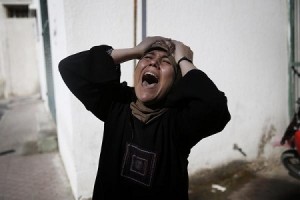
Tuesday September 02, 2014 10:00 by Saed Bannoura - IMEMC News This list is constantly updated due to the ongoing Israeli assault on Gaza since July 8th. The following 1598 names have been confirmed - the actual death is at least at 2137. Woman who lost her family (image by Amnesty International) We realize the number of slain Palestinians is higher than this. The Ministry of Health has stated that a total of 2137, been killed.
by SHLOMO SAND AUGUST 28, 2014 When the muses thunder, the guns stay silent. The adage, habitually inverted, is inaccurate. The propaganda sirens are never as loud as when the cannons, the planes and helicopters buzz and spit their fire. The television chains, in Israel and elsewhere, with their journalists, commentators and special correspondents have, between the advertising, presided over the spilled blood which few amongst them appear to attach much importance.
July 12, 2014 – Israeli residents, mostly from Sderot, sit on a hill overlooking the Gaza Strip to watch Israeli bombardment of Gaza. (By Menahem Kahana/AFP/Getty Images) When Akkas Al-Ali's Israeli friend accused him of "siding with terrorists" in Gaza, he decided to write the following letter in response. Wednesday, August 27, 2014 By Akkas Al-Ali By now, I expect you are fully aware of the apocalyptic scenes that have been coming out of Gaza over the past few weeks.
Nazmi Al-Masri
August 25, 2014
This day is carved in my memory.
As all academics in Gaza, I had given much thought to my students who were suffering all sorts of agonies and worries caused by Israel’s aggression. After 40 days of atrocities caused by heavy bombardment and random artillery shelling, which destroyed thousands of houses and devastated countless families, the Islamic University of Gaza (IUG) did everything it could to make use of the three-day temporary ceasefire, which was extended for five days and then for another 24-hour period before it ended at midnight on August 19th, 2014.
Gaza and Palestine, by Ema Abu Shtayyeh Antoun Issa Posted: 08/25/2014 The resumption of fighting between Israel and Hamas can be largely attributed to Egypt's failure to broker a fair, enduring cease-fire. Egypt's cease-fire proposal, as outlined in 11 points, was effectively a call for a return to the status quo: a besieged Gaza Strip with token, unspecified assistance to help it rebuild - the third reconstruction Gaza will have to undergo in less than seven years.
ARGUMENT As Israel and the Palestinians struggle to reach yet another cease-fire, the mediators in Cairo are making the conflict worse -- and empowering radicals in the process. BY MICHELE DUNNE , NATHAN J. BROWN AUGUST 18, 2014 As negotiations on a lasting cease-fire in Gaza grind on in Cairo, it's not only the animosity between Israel and Hamas that is complicating the talks -- it's also Egypt's role as mediator.
by Basem L. Ra'ad Behind the blinding media rhetoric and deceptive narratives and justifications, and digressions from root issues, the latest attacks on Gaza are part of a larger plan. Christian Palestinians voted overwhelmingly for Hamas in 2006. I was in the Jerusalem area, and in Ramallah and Bethlehem, and witnessed this unusual turn. It wasn’t the decisive factor in the crushing win by Hamas over the Authority led by Fatah, but it carried much meaning.
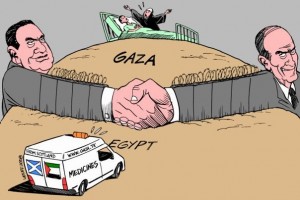
Posted by Baheyya 12 Aug 2014 01:28 PM PDT In the old days, when the Israeli military bombed and shelled Palestinians and sought to destroy their society, Hosni Mubarak used a well-worn formula, fully abetting Israeli actions while uttering pro-Palestine platitudes. Occasionally, when huge protests rocked the streets, he green-lighted theatrical gestures such as his wife heading a relief convoy to Gaza in 2002, and his son fronting a delegation to Beirut when Israel bombed Lebanon in 2006.
Philip Rizk Thursday, August 14, 2014 - 18:33 I met Bassem Mohsen for a few moments in July 2013. He was upbeat and hopeful that the army had taken hold of power from the Muslim Brotherhood. I remember being surprised by his quick optimism. He believed that these generals were different than those who had ruled during the period of the Supreme Council of the Armed Forces, following former President Hosni Mubarak’s ouster.
Israel's latest war brought its increasingly fascist politics before a global audience. By Scott McConnell • August 6, 2014 Throughout the 1950s and 1960s and continuing through the present, the central issue in the study of European history was the rise of Nazism. Not the documenting of the facts of the long descent to the Holocaust, though this was essential to the enterprise. But the trying to understand how a country that was in many ways the most advanced in Europe could descend so far so fast.