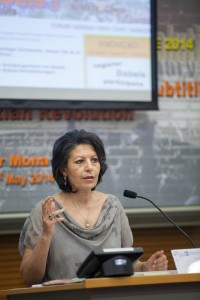
Professor Martha Cheung Memorial Lecture, May 2014, Hong Kong Baptist University Mona Baker, Centre for Translation & Intercultural Studies, University of Manchester The idea of prefiguration originally derived from anarchist discourse; it involves experimenting with currently available means in such a way that they come to mirror or actualize the political ideals that inform a movement, thus collapsing the traditional distinction between means and ends. Practically all the literature on prefiguration has so far focused on structural, organizational and interactional issues.
"Peoples Library Occupy Wall Street 2011 Shankbone" by David Shankbone - Own work. Licensed under CC BY 3.0 via Wikimedia Commons. Jonathan M. Smucker
October 7, 2014,
Berkeley Journal of Sociology
Occupy Wall Street participant Jonathan Smucker takes a critical look at the movement’s “prefigurative politics” through the theoretical lenses of Gramsci and Habermas. What is politics? In this essay, I examine so-called “prefigurative politics” as it played out in Occupy Wall Street (OWS)—through Gramscian and Habermasian theoretical lenses.
Marianne Maeckelbergh argues that one of the global justice movement's key innovations has been its approach to democratic decision-making December 2009, in Red Pepper It was getting late on day two of seemingly hopeless meetings. The assembly hall was full, but the energy with which the discussion began was waning fast. People had travelled to Paris from across Europe for this European Social Forum (ESF) planning meeting, but the pressure of the task at hand was starting to weigh heavily.
Video recording of presentation by Marianne Maeckelbergh at the Prefiguration in Contemporary Activism Workshop, 4 December 2014, University of Manchester.
A CTIS/CIDRAL Workshop: 4 December 2014 Keynote Speaker: Marianne Maeckelbergh (Institute of Cultural Anthropology and Development Sociology, Leiden University, Netherlands; Co-founder of Global Uprisings)
Click here for programme and abstracts
Prefiguration, or ‘prefigurative politics’, involves experimenting with ways of enacting the principles being advocated by an activist group in the here and now, rather than at some future point when the conditions for the ‘ideal society’ have already been created, thus collapsing the traditional distinction between means and ends.
by Guiomar Rovira Sancho, Universidad Autónoma Metropolitana, Mexico Guiomar Rovira Sancho, Universidad Autónoma Metropolitana, Carlos Lazo 218, int 2, Col. M.Hidalgo, cp. 14250, Mexico City, Mexico. Email: ondina_peraire@yahoo.com Published online before print July 15, 2014, doi: 10.1177/1354856514541743 ConvergenceJuly 15, 20141354856514541743 Abstract E-mail and Web pages made it possible to generate a space for global mobilization against the repression of the Zapatista indigenous rebels in the 1990s. The global justice movement that started in Seattle in 1999 extended global networks to organize action.