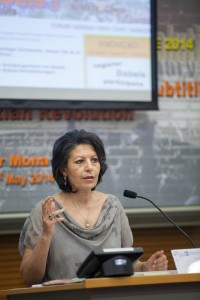
Professor Martha Cheung Memorial Lecture, May 2014, Hong Kong Baptist University Mona Baker, Centre for Translation & Intercultural Studies, University of Manchester The idea of prefiguration originally derived from anarchist discourse; it involves experimenting with currently available means in such a way that they come to mirror or actualize the political ideals that inform a movement, thus collapsing the traditional distinction between means and ends. Practically all the literature on prefiguration has so far focused on structural, organizational and interactional issues.
New Left Review 13, January-February 2002 DAVID GRAEBER Is the ‘anti-globalization movement’ anything of the kind? Active resistance is true globalization, David Graeber maintains, and its repertoire of forms is currently coming from the arsenal of a reinvented anarchism. It’s hard to think of another time when there has been such a gulf between intellectuals and activists; between theorists of revolution and its practitioners. Writers who for years have been publishing essays that sound like position papers for vast social movements that do not in fact exist seem seized with confusion or worse, dismissive contempt, now that real ones are everywhere emerging.
"Peoples Library Occupy Wall Street 2011 Shankbone" by David Shankbone - Own work. Licensed under CC BY 3.0 via Wikimedia Commons. Jonathan M. Smucker
October 7, 2014,
Berkeley Journal of Sociology
Occupy Wall Street participant Jonathan Smucker takes a critical look at the movement’s “prefigurative politics” through the theoretical lenses of Gramsci and Habermas. What is politics? In this essay, I examine so-called “prefigurative politics” as it played out in Occupy Wall Street (OWS)—through Gramscian and Habermasian theoretical lenses.
Marianne Maeckelbergh argues that one of the global justice movement's key innovations has been its approach to democratic decision-making December 2009, in Red Pepper It was getting late on day two of seemingly hopeless meetings. The assembly hall was full, but the energy with which the discussion began was waning fast. People had travelled to Paris from across Europe for this European Social Forum (ESF) planning meeting, but the pressure of the task at hand was starting to weigh heavily.
A CTIS/CIDRAL Workshop: 4 December 2014 Keynote Speaker: Marianne Maeckelbergh (Institute of Cultural Anthropology and Development Sociology, Leiden University, Netherlands; Co-founder of Global Uprisings)
Click here for programme and abstracts
Prefiguration, or ‘prefigurative politics’, involves experimenting with ways of enacting the principles being advocated by an activist group in the here and now, rather than at some future point when the conditions for the ‘ideal society’ have already been created, thus collapsing the traditional distinction between means and ends.
Special Thematic Section Journal of Social and Political Psychology Guest Editors: Jan Haaken, Flora Cornish, Catherine Campbell, Sharon Jackson, Liora Moskovitz The early 21st century proliferation of small-scale social movements in the Global North and South provides the context for this special section. 'Prefigurative politics' emerged in the 1970s as a term that expressed the ethos of creating alternative communities – fostering small-scale experiments in modes of living and working that realize in the present the values of an anticipated better society.