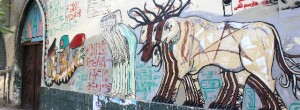
Photo by: Laura Gribbon. Alaa Awad's work on Mohamed Mahmoud Street Cultural producers who gained fame after the revolution Sunday, January 25, 2015 - 09:53 By: Rowan El Shimi; Laura Gribbon; Amany Ali Shawky
We take a look at the trajectories of four cultural producers who gained fame during or after the January 25 revolution and find out what they're doing now.
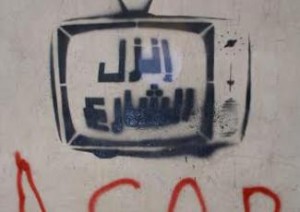
Graffiti in Cairo depicting a television with the text "Go down to the streets" Sep 05 2014 The 2011 revolutionary uprisings in the Middle East and North Africa abruptly captured global attention as the world was drawn breathlessly into the tumult with a profusion of media content, from Tweets to amateur video footage. Amidst the media blitz, analyses yielded two conflated and reactionary narratives of events. One contended that the popular protests of the so-called “Arab Spring” were wholly unexpected, a shocking diversion from the familiar politics of the Middle East in a seeming contravention of the reigning global political apathy at the turn of the millennium.
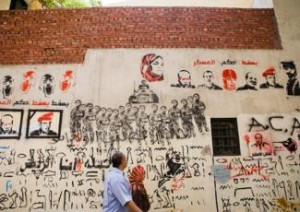
[Image from Hossam El-Hamalawy] by Hannah Elansary Sept 01 2014 The graffiti and street art of revolutionary Egypt have been researched many times over by now.Journalists and scholars have explored the phenomenon in its many aspects—as evolving visual text, as political rhetoric and as an act of protest in its own right. The claims about the protest street art and graffiti that have proliferated across public Egyptian walls since 2011 have been many, and include: the spread of revolutionary graffiti in Egypt was a sign and act of citizens reclaiming public space from the regime; street art worked to raise awareness and build community and solidarity among people; street art served as a tool by which citizens could (re)claim agency, assert identity, and create their own historical narratives.
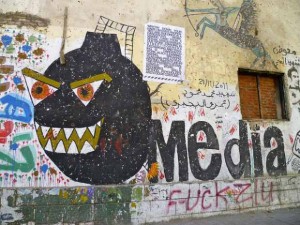
Street art from Mohamed Mahmoud Street, Cairo. (Photo: Melody Patry/Index on Censorship) Graffiti artists face threats of violence, and the potential of jail time and fines under a proposed draft law
By Shahira Amin / 22 August, 2014
Before the January 2011 uprising, street art was little known in Egypt. Then came the revolution and with it, an outburst of creativity. With the fall of the authoritarian regime of Hosni Mubarak, Egyptian artists who had routinely faced censorship restrictions under his autocratic rule, felt a strong urge to break out of the confines of their studios and reclaim public spaces.