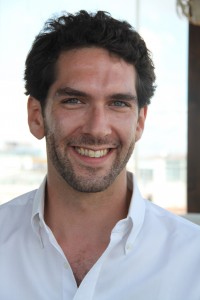
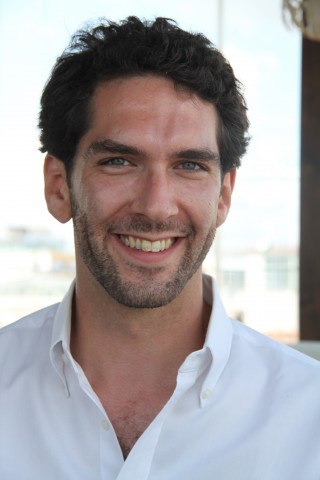
Sherief Gaber As Interviewed by Elizah Flores, March 30, 2011 Whatever connection I had with Egypt was just screaming at me that I had to go. Introductory Profile: About Sherief Gaber
Sherief Gaber is a twenty-six year-old graduate student at the University of Texas studying law and urban planning. He grew up in Memphis and went to college in Saint Louis. His parents came to America from Egypt shortly before he was born.
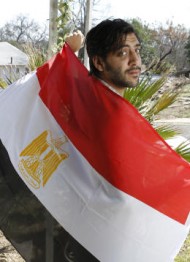
Published on February 28, 2011 at 12:00 am By Allie Kolechta A UT graduate student stood with protesters in downtown Cairo as they barricaded themselves against military attacks and fought for a revolution in the midst of former President Hosni Mubarak’s resignation. Law and urban planning graduate student Sherief Gaber flew straight into Cairo on Jan. 30 to join the protests in Tahrir Square before Mubarak stepped down from the Egyptian presidency.
21 August 2013, Mada Masr By Sherief Gaber "You want to see the bodies? Ok then, here!" the man working at the morgue said, holding me and a friend by the arm and practically pushing us into a humid room filled with bodies, lying on slabs or on the floor and in various states of decay. We had been at the morgue for over an hour, coming from the tear gas and shooting in Mohamed Mahmoud Street to Zeinhom, Cairo's only morgue, because we had heard that medical examiners were refusing to autopsy the bodies of those shot by the police and military in the clashes.
09-10-2013, Mada Masr By Sherief Gaber Two years ago today, just after sunset, the Egyptian army murdered 28 people in the span of perhaps fifteen minutes. Many were shot, several were run over by armored vehicles zigzagging up and down the Corniche, and all this took just fifteen minutes. Bodies were carried into the lobby of an apartment building, held there for fear of what would be done to them if they were found by the soldiers outside who were seething with rage, hatred and a violent impulse that one can scarcely understand, even now.
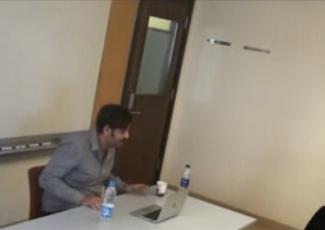
by Middle East Studies Center at AUC Jadaliyya, 24 February 2014 On 19 February 2014, the Middle East Studies Center at the American University in Cairo hosted Sherief Gaber, a member of the Mosireen film collective and researcher in housing rights and community development, for a lecture titled “Mosireen and the Battle for Political Memory.’’ Gaber discussed the mission and activities of the Mosireen film collective. Mosireen, or ”We are determined,” is a non-profit media collective dedicated to preserving and sharing images and video documenting the extraordinary events during and since the January 2011 Egyptian uprising.
Guernica, 15 May 2014 By Jonathan Guyer The country’s cartoonists find creative ways to defy censors. His face is almost everywhere. With a stoic gaze and a stately uniform, Field Marshal Abdul-Fattah Al-Sisi looks out from magazine covers displayed at Cairo’s corner newsstands and posters decorating gas stations in sleepy Red Sea towns. Following the military’s ouster of the Muslim Brotherhood-affiliated Mohammed Morsi last July, a nationalistic fervor has gripped Egypt, and media outlets have widely lionized the retired general.
14 August 2013, The New Yorker By Jonathan Guyer n Egypt, political cartoons leap off the page and into public places, from street art to high-class galleries, on leaflets and TV programs. At the Muslim Brotherhood’s sit-in at Rabaa al-Adawiya, in the Nasr City neighborhood of Cairo, where protesters spent more than a month protesting the ouster of President Mohamed Morsi, cartoons were a form of resistance. A tent hosted an improvised gallery of comics from Brotherhood-affiliated newspapers; canvas walls at the back entrance displayed demeaning caricatures of the military and Photoshopped images of figures like the Coptic Christian Pope.
22 May 2014, The New Yorker
By Jonathan Guyer
Everybody knows who Egypt’s next President will be. Elections are scheduled for May 26th and 27th, almost a year after Mohamed Morsi was ousted in a coup led by the retired general Abdel Fattah Al-Sisi, in what has been painted as a second revolution. With campaigning in overdrive, Sisi met with a delegation of artists on May 12th. According to local news reports, the candidate said that artists are “the heart and soul of the nation,” and its conscience.
Samah Selim This essay explores some of the problems associated with activist translating in revolutionary historical moments like the one that began in Egypt in 2011. Using my experience of working as a subtitler with the radical video collective Mosireen in 2012/13, I reflect on how the process and experience of translating in a state of emergency – when the state mobilizes its arsenal of violence on the streets – profoundly shapes how we think about terms like ‘profession’ and ‘objectivity’, and about the roles of both translator and audience in building effective cross-border virtual solidarity networks in real time.