Call for Articles—Alif 38, 2018
Guest-edited by Mona Baker
Abstract deadline: October 1, 2016
Article submission deadline: May 1, 2017
The point of departure for this special issue of Alif is that knowledge is ‘produced’ rather than ‘discovered’, and that translation is a core mechanism for the production and circulation of all forms of knowledge. This topic has received relatively limited attention in translation studies to date, and even less in related disciplines such as cultural studies and the history of ideas.
BY MLYNXQUALEY on APRIL 20, 2015
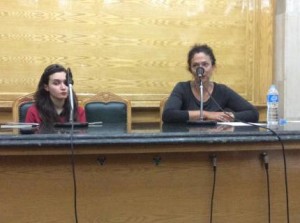
Samah Selim spoke at Cairo University last Thursday, at a talk moderated by Nada Abdel Sobhi, on “Why We Transate: Some Notes on Love, Loss, and Longing.” Mona Elnamoury was there:By Mona ElnamouryIn her talk at Cairo University last Thursday, Samah Selim charmed the audience with her hearty genuine talk about translation and love. Selim came to talk about translation in general as well as her current project: Arwa Saleh’s non-fiction book Al-Mubtasarun: dafatir wahda min gil al-haraka al-tullabiyya, which was published in 1997, the same year its author took her life.
Mona Baker is interviewed by Andrew Chesterman 2008. Cultus 1(1): 10-33. Click on the link below to download a copy of the interview. Baker Ethics of Renarration 2008 Opening question and answer quoted below. In lieu of an abstract. Chesterman: Your recent book Translation and Conflict. A Narrative Account (2006a) raises some interesting and important issues concerning the practice and ethics of translation and interpreting. You argue that translation is especially significant in conflict situations, and (like most human inventions, I suppose) can be used both for good and for ill.
Mona Baker Centre for Translation & Intercultural Studies School of Languages, Linguistics and Cultures University of Manchester, UK Published in the SKASE Journal of Translation and Interpretation, ISSN 1336-7811 Volume 1, Number 1, 2005 Abstract. This article questions one of the narratives that dominate our disciplinary and professional discourses on translation, namely the narrative of translation as a means of promoting peace, tolerance and understanding through enabling communication and dialogue to take place.
Preview of Mark Nickolas documentary film Nefertiti's Daughters, featuring some of the most interesting street artists in Egypt. LOG LINE: Queen Nefertiti returns to join revolutionary street artists on the front lines in the fight for women’s rights and freedom in Egypt.
SYNOPSIS: Nefertiti’s Daughters is a story of women, art and revolution. Told by prominent Egyptian artists, this documentary witnesses the critical role revolutionary street art played during the Egyptian uprisings.
ISIT, Damascus University, Syria, Part 1
February 2011
محاضرة للدكتورة منى بيكر، أستاذة دراسات الترجمة ومديرة مركز الترجمة والدراسات الدولية في جامعة مانشستر بإنجلترا، قدمت بناء على دعوة في المعهد العالي للترجمة والترجمة الفورية في جامعة دمشق. في بداية المحاضرة، تعرف الدكتورة ريما الحكيم، عميد المعهد العالي العالي للترجمة والترجمة الفورية في جامعة دمشق، بالمحاضرة وتقدم نبذة قصيرة عنها وعن تاريخها الفكري والسياسي في مناصرة القضايا الإنسانية ومنها القضية الفلسطينية. عنوان المحاضرة هو "
Plenary 4 تغييــــــر الأطـــــــر وخطـــــوط الصـــــدع
خالد عبد الله
Abstract The story of the Egyptian revolution carries a heavy burden. Its many tales travel across contexts and experience, within Egypt and beyond it, influencing movements and revolutions while building dreams and threatening them. Solidarity fundamentally entails sharing an interpretation of a story. How that story is told and re-told has political and historical implications that are as much about the current moment as they are about the future.
Plenary 3 الترجمة والتضامن في مشروع الفيلم التسجيلي كلمات نساء من الثورة المصرية
ليل زهره مرتضي
Note: This plenary was delivered via Skype, in the format of a conversation with Mona Baker and the audience, because the Egyptian authorities refused to grant Leil a visa. Abstract Translation has been an integral part of Words of Women from the Egyptian Revolution from its very first stages. Subtitling the speech of the women interviewed into a variety of languages is not just an issue of disseminating information and making their unique experiences accessible to as many people as possible, but is part of a broad expression of political commitment that assumes different forms.