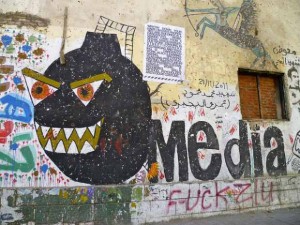
Street art from Mohamed Mahmoud Street, Cairo. (Photo: Melody Patry/Index on Censorship) Graffiti artists face threats of violence, and the potential of jail time and fines under a proposed draft law
By Shahira Amin / 22 August, 2014
Before the January 2011 uprising, street art was little known in Egypt. Then came the revolution and with it, an outburst of creativity. With the fall of the authoritarian regime of Hosni Mubarak, Egyptian artists who had routinely faced censorship restrictions under his autocratic rule, felt a strong urge to break out of the confines of their studios and reclaim public spaces.
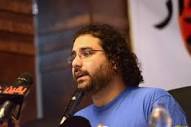
By Omar Robert Hamilton Wednesday, August 20, 2014 - 07:33 After three spells of imprisonment since the start of the revolution, Alaa Abd El Fattah has declared that he is starting a hunger strike. Alaa is one of 25 people who were sentenced to 15 years in prison for attending/organizing a protest in November. A protest in which a policeman who was filmed strangling a young woman fell over and lost his walkie talkie.
by Philip Rizk Tuesday, January 28, 2014 - 17:42 Editor’s note: If the Palestinian struggle has taught us one thing, it is not to forget, to remember, to retell our stories of resistance over and over again. And it might be that Egypt’s revolutionary voices have hit a point, where remembering, revising and retelling is at the epicenter of their resistance. In this spirit, we asked Philip Rizk to use this space to retell his story of the revolution, as he wrote it in 2012.
By Omar Robert Hamilton Tuesday, December 24, 2013 - 01:14 The light is different in Zeinhom. The narrow street, arching trees and gentle slope of one of Cairo’s only hills combine to soften the bright, direct light that casts the city in her familiar monochrome. The light comes at you at an angle. Maybe it’s the hill. Or maybe it’s because I only go to Zeinhom early in the morning, to go to the city morgue.
Saturday, August 17, 2013 - 22:26 by Omar Robert Hamilton I sit, for the 12th hour now, alone and struggling for what to do. For the first time since I got on a plane for Egypt on January 29, 2011, I am at a loss. Worse days than today lie ahead of us. We thought we could change the world. We know now that that feeling was not unique to us, that every revolutionary moment courses with the pulse of a manifest destiny.
Philip Rizk Thursday, August 14, 2014 - 18:33 I met Bassem Mohsen for a few moments in July 2013. He was upbeat and hopeful that the army had taken hold of power from the Muslim Brotherhood. I remember being surprised by his quick optimism. He believed that these generals were different than those who had ruled during the period of the Supreme Council of the Armed Forces, following former President Hosni Mubarak’s ouster.