Peter Funke New Media & Society, Volume 16, Number 3, 2014 Todd Wolfson and Peter N Funke Abstract Understanding class as a process of self-making in relation to a particular, historical form of capitalism, in this article we argue that media and communication (from face-to-face and old mediums such as radio to internet-powered tools) must be conceptualized as an emerging structural dimension for class formation. Based on ethnographic fieldwork on the Media Mobilizing Project in Philadelphia, a community-based media and communications infrastructure and a network of organizations across the region, we develop a conceptual approach we call concentric practices, which provides us with a framework of how contemporary class formation is occurring through the use of media and communications.
Triple C: Communication, Capitalism and Critique Volume 10, Number 1, 2012 Abstract Due to the increasingly atomized, isolated nature of social life, as well as the apparent splintering of the working class under neoliberal capitalism, media serve a pivotal infrastructural function for generating the necessary commonality between the fractured sectors of the contemporary working class. This article ethnographically and textually examines how the media driven practices of the Philadelphia-based Media Mobilizing Project helps collectively suture fragmented groups of workers into a class formation that begins to resist and challenge the hegemony of neoliberal practices.
Peter Funke Social Movement Studies, Volume 13, Issue 3, 2014DOI: 10.1080/14742837.2013.831755Peter Nikolaus Funkea & Todd Wolfsonb* pages 349-364 Published online: 19 Sep 2013 Abstract This article starts out by distinguishing between communication and communication mediums when examining social movement-powered formations of collective identity and collective action. We then focus on communication mediums to examine the different ways that old and new media are utilized in urban social movements under neoliberal capitalism.
Professor Martha Cheung Memorial Lecture, May 2014, Hong Kong Baptist University Mona Baker, Centre for Translation & Intercultural Studies, University of Manchester The idea of prefiguration originally derived from anarchist discourse; it involves experimenting with currently available means in such a way that they come to mirror or actualize the political ideals that inform a movement, thus collapsing the traditional distinction between means and ends. Practically all the literature on prefiguration has so far focused on structural, organizational and interactional issues.
Published on Feb 26, 2014 The Ethics and Politics of Translation: A Public Lecture Day: Monday 9/12/2013 Venue: Room (13), English Department, Cairo University Speaker: Mona Baker,, University of Manchester Chair: Hoda Elsadda, Cairo University
Philip Rizk, a blogger and peace activist, was released days after being detained by Egyptian security forces after his participation in a march to raise awareness about conditions in Gaza. Christina Rizk By MICHAEL SLACKMAN FEB. 11, 2009, The New York Times CAIRO — For more than four straight days, Philip Rizk said, he was blindfolded, handcuffed and interrogated around the clock by Egyptian state security agents who abducted him on Friday after he took part in a march in support of Gaza.
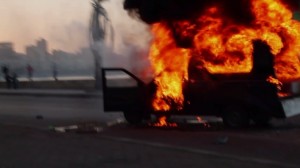
Why Riot?, video by Mosireen Video Collect, 2013.
“The revolution is not a thing of the past, the revolution is still in process.” Philip Rizk stated as we began our discussion of his text “2011 is not 1968”, whereby he challenges the dominant narratives of the January 25th Revolution as a youth lead revolution. He argues that the radicalizing factor of the uprising was an underclass without leaders.
DevelopmentEducation.ie Action Projects AUTHOR DETAILS Colm Regan 80:20 Educating and Acting for a Better World - www.8020.ie The mural was co-ordinated by John Johnston of 80:20 (now with Goldsmith’s College, London) and Valarie Duffy (now with the National Youth Council of Ireland). PARTICIPANTS Young people 14+; over 9 schools and two youth organisations from East Belfast and the Republic of Ireland Phase 1 of the project was led by Alternatives in East Belfast and Presentation College, Bray, Co.
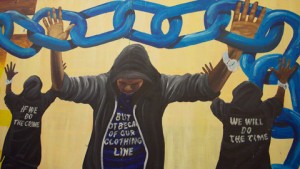
‘I Am Here’ mural detail. Pic: Laura Liszewski EAST LONDON LINES December 3, 2012 | Posted by: Laura Liszewski | Three scenes stand side by side, occupying a vibrantly painted mural. On the far left, a menacing officer’s mouth opens wide to expose a prisoner behind bars, on the far right hooded youths stand, pressed against walls and try to reach through blue chains, while in the middle of it all a peaceful man tends delicate flowers as white doves fly towards a yellow rising sun.
Leil-Zahra Mortada Translation has been an integral part of Words of Women from the Egyptian Revolution from its very first stages. Subtitling the speech of the women interviewed into a variety of languages is not just an issue of disseminating information and making their unique experiences accessible to as many people as possible, but is part of a broad expression of political commitment that assumes different forms. First and foremost, it is part of a wider postcolonial and feminist commitment to allowing the subjects themselves to shape their own voices and representations.