09/06/2015, 2 PM, County Main SR5 The Arab and Muslim Worlds Research Forum invites you to: Language Gender and the Egyptian Revolution: An interactive workshop Presenter: Shaimaa El Naggar (LAEL) Discussant: Dr Shuruq Naguib (PPR) Produced in 2012, “Words of women from the Egyptian revolution” is a YouTube series about women’s engagement in the Egyptian uprisings, directed by Leil Zahra Mortada. Each YouTube video interviews women who reflect upon their participation in the Egyptian uprisings that started in 2011.
Egypt Today 21 September 2013 A new project to shed light on women’s role during January 25 By Nadine El Sayed After January 25, people thought feminism will finally get its break in Egypt, only to be faced with an unrepresentative female minority in the parliament, a crackdown on women’s march last year and an overall undermining of women’s role in the political scene.But Words of Women from the Egyptian Revolution documentary series hopes to contribute in writing history through telling and highlighting women’s stories duringJanuary 25, as told by them.
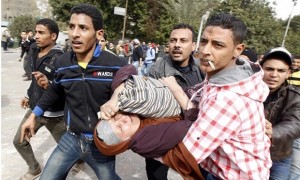
Protesters near Tahrir Square in Cairo help a woman overcome by teargas. Photograph: Mohamed Abd El Ghany/Reuters Campaigners in Egypt say at least 25 women have been assaulted as state of emergency is declared in three provinces Patrick Kingsley in Cairo
Monday 28 January 2013
Amid Egypt's ongoing civil unrest, at least 25 women have been sexually assaulted during clashes in Tahrir Square, according to local women's rights campaigners. In a typical attack, crowds of men quickly surround isolated women, groping them and attempting to remove their clothes.
Posted by Leil-Zahra on 11/12/13 • Categorized as English
I was a bit disappointed when I read Žižek´s article on Syria. It is true that the people in Syria have no excuse for not making a revolution, but compassion is a virtue. Maybe if “comrade” Žižek could´ve taken the time to scribble them a manual of “Revolution 101″ they could´ve been brought to their senses. Possibly a syllabus of recommended readings?
Posted by Leil-Zahra on 12/29/14
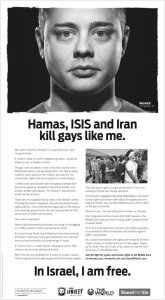
* In response to a full-page ad running this week in The New York Times funded by Rabbi Shmuley, Stand with Us, and This World (Shmuley’s own); featuring political campaigner Rennick Remely. My name is Leil-Zahra Mortada. I’m an Arab Queer person. And I support justice. If I lived in Gaza or “Israel’s neighboring states”, I would be thrown in jail, mutilated or killed. I have a higher chance of getting mutilated or killed by an Israeli war than getting jailed for my homosexuality by an Arab or Islamist regime.
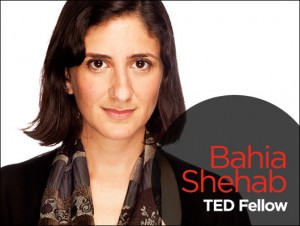
Bahia Shehab During the Egyptian revolution, art sublimated violence and translated emotions. Music, theatre, video art, graffiti and cartoons were just a few examples of media of protest that overtook the streets and cyberspace. Strong emotions brought about intense creativity, and in the process artists and laymen alike provided us with exceptional examples of how to express dissidence and solidarity aesthetically. Focusing on graffiti, I engage with examples of collaborative creative protest and my own contribution to them, and treat the palimpsests that emerged out of the interaction among graffiti artists and between them and the public as a form of visual conversation.
Published on May 21, 2013 Reviving calligraphy and shaping the future of script through her students, Bahia Shehab, Associate Professor of Practice in the Department of the Arts, works on the first ever encyclopedia of the Arabic script.
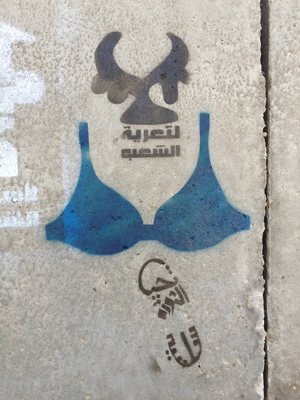
No to Stripping BY Nama Khalil 2 September 2014, Design and Violence From the curators: Using sexual violence to intimidate, crack down on dissent, or brutalize opposition is nothing new. Neither is graffiti—illicit drawings are older than Pompeii. However, such designs have taken on new life of late, paralleling an increased public and political focus on female sexuality. During the wave of disparate yet interconnected protests that made up the Arab Spring (2010–ongoing), graffiti emerged as an untamable form of grassroots resistance to such violence.
https://vimeo.com/89910610 24 March 2014, Louisiana Channel "Graffiti is like flowers. They are beautiful, but they don't live long." An interview with Lebanese-Egyptian street-artist Bahia Shehab about the role of art during the Arab spring: "You cannot resist ideas. They can travel into any mind." "I am a quiet person, I don't know how to scream", says Bahia Shehab. "My contribution to the revolution was to paint on the walls, was to be an artist.
Posted by: Karen Eng September 7, 2012 TED Blog When art historian and scholar of Arabic script Bahia Shehab was asked to create a piece commemorating the centenary of the first exhibition on Islamic art in Europe, little did she know that the Egyptian revolution would ultimately transform her into a street artist and activist with a powerful and subtle voice of protest. How did your work with the character for “no” begin?