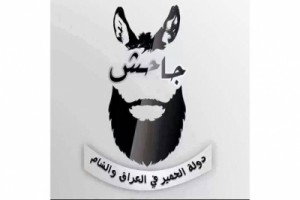
'Da'ish' becomes 'Ja'hish' - "The state of donkeys in Iraq and Syria". By Alice Guthrie on 19/2/15
Arabic translator Alice Guthrie investigates 'Daesh', the new name for ISIS recently adopted by several world leaders because it delegitimises the group's activities. But how can a new name undermine a terrorist organisation? And why do the English-speaking media find the name so difficult to understand?
Over the last few months, there has been a concerted effort by several senior global politicians to give a new name to the group known as ISIS, or Islamic State, IS or ISIL.
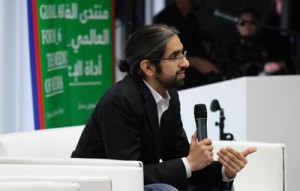
London, 25 February 2015 – Emirati scholar and writer Sultan Sooud Al Qassemi has officially launched the Alexandria Trust's translation project by committing to support the Arabic translation of the first two titles from an all new library of short texts offering analysis and critique of seminal books, across 14 disciplines in the humanities and social sciences, from all over the world.
This library is being developed in English by the Trust's sister organisation, Macat International, and is due for public launch in 2015.
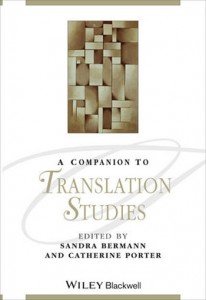
By: Eric Becker Published on January 6, 2015 Recently, I had the privilege to talk withCatherine Porter and Sandra Bermann about the release of their new book, A Companion to Translation Studies. Their book features 45 essays from leading translators, including the late Michael Henry Heim, that range from high-level investigations of the art to inquiries on specific quandaries facing the translator. With this new work, Porter and Bermann aim to bridge the gap between the academic and the casual reader.
This is an exceptional collection of digitised books like Kalilah wa Dimna and Alf Layla wa Layla, now available to the public to read online. Illustrated mss on LUNA (as bookreaders) Arabic MS 486 (2) Kalilah wa Dimna http://enriqueta.man.ac.uk/luna/servlet/s/z3z9mt Arabic MS 487 (537) Kalilah wa Dimna http://enriqueta.man.ac.uk/luna/servlet/s/av64bz Arabic MS 646 (706) Alf Layla wa Layla http://enriqueta.man.ac.uk/luna/servlet/s/1ger41 Arabic MS 658 (819) Qissat Shimas http://enriqueta.man.ac.uk/luna/servlet/s/7wldcm Arabic MS 358 (382) Book of Conics 1848 http://enriqueta.
DOI: 10.1080/0305764X.2014.991277Helen Colley& Frédérique Guéry Published in:
Cambridge Journal of Education Volume 45, Issue 1, 2015 Special Issue: Evoking and Provoking Bourdieu in Educational Research pages 113-131 Abstract Public spending reductions across the advanced capitalist world are creating new professions that have a ‘hybrid’ status and/or role. However, research on professional learning has paid little attention to them. This qualitative study of one such profession, public service interpreting (PSI), addresses that lacuna.
The University of Oslo Department of Culture Studies and Oriental Languages Job Description A full time position as University Lecturer in Arabic at the Department of Culture Studies and Oriental Languages is available from 15th of August 2015 The position as University Lecturer is a teaching position without research duties. A part of the position (25 percent) is, however, set aside for professional and academic development and administrative work. The holder of this position will be one of two University Lecturers teaching Arabic language in cooperation with other faculty members.
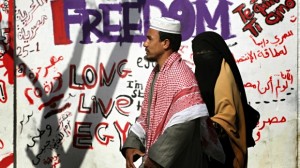
Revolutions in language … a Cairo street scene two days after Hosni Mubarak was ousted from power in 2011. Photograph: John Moore/Getty Images What do words such as 'freedom' or 'coup' mean in Egypt today? One artist is collecting definitions from across a divided nation Patrick Kingsley Cairo
Friday 18 July 2014
as it a coup? Was it a revolution? The overthrow of Mohamed Morsi last July spawned unending debate in Egypt about how the president's removal should be defined.
BY MLYNXQUALEY on FEBRUARY 4, 2015
On January 31st, A Dictionary of the Revolution launched a kickstarter to boost the project toward its final phase:
This fund-raising campaign is focused on building the dictionary a digital text and sound archive for the material that Amira Hanafi and her team have collected in the past year. Through one-on-one interviews, leaping off from particular hot-button words, “A Dictionary of the Revolution makes space for viewpoints that are no longer represented in the media or in the Egyptian public.
TransCulturAl: A Journal of Translation and Cultural Studies A lot of research has been done on women in translation since Lori Chamberlain wrote “Gender and the Metaphorics of Translation” in 1988 and argued that writing was marked “to be original and ‘masculine’ and translation “to be derivative and ‘feminine’” (254). Women’s work as translators has been revalorized, women writers are being translated, women translators appear more often in fiction and gender issues in translation have raised a lot of interest among translators and scholars.
Monday, 26 January 2015 by Mahmoud Al-Hirthani One field in which Palestinian intellectuals and writers have invested heavily, particularly since the Nakba in 1948, is translation. Interestingly, translating from Russian preceded translation from English due to the early exposure of Palestinian intellectuals to Russian literature, disseminated in Palestine via Russian schools and missionaries during the 19th century. Translation from English started to flourish in the 1920s. While translating from Russian focused on fiction, with translators such as Khalil Baidas as pioneers, translation from English focused more on political works during the British Mandate (1920-1948), influenced by the Pan-Arab awakening against British rule throughout the region.