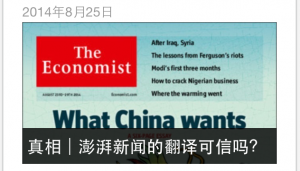
Netizens cry foul when a new Chinese media outlet selectively translates an Economist cover article. By BETHANY ALLEN-EBRAHIMIAN SEPTEMBER 3, 2014 On July 22, a glossy new Chinese media venture known as the Paper announced its launch to much fanfare. A subset of Shanghai's state-run Oriental Morning Post with outside investment estimated at $32 million, the Paper seems to be a venture into state-funded public service journalism. The timing is appropriate, coming as the influence of staid party mouthpieces has diminished while new media has flourished among China's increasingly internet-savvy populace.
Guest editors: Lucía Ruiz Rosendo (University Pablo de Olavide) & Clementina Persaud (University Pablo de Olavide) The figure of the interpreter as an intercultural and linguistic mediator in zones devastated by conflict has always existed due to the fact that conflicts have been intrinsic to the development of history. The distinctive trait of these interpreters is that, unlike other interpreters who are seldom in danger when exercising their profession, they risk being subjected to psychological and emotional pressure or physical harm and are often unable to find politically or linguistically neutral spaces, and the combatants do not recognise them either (Kahane 2008).
Maastricht-Łódź Duo Colloquium Organisation The overall organisation of the International Maastricht-Łódź Duo Colloquiums is in the hands of the Maastricht School of Translation and Interpreting of Zuyd University of Applied Sciences (The Netherlands) and the Department of Translation Studies of the Institute of English Studies of the University of Łódź (Poland). The founders of the Maastricht-Łódź Duo Colloquiums are Dr. Marcel Thelen and Prof. Ordinarius Dr. Habil. Barbara Lewandowska-Tomaszcyk , respectively.
Location: Qatar National Convention Center, Doha, Qatar
Deadline for proposals: October 30th, 2014 Conference dates: March 23rd – 24th, 2015
Conference is organized by: Translation and Interpreting Institute (TII) “Beyond Fault Lines: Translating ‘the Gulf’” is the sixth in a series of annual international conferences that aim to create a Gulf-based platform for discussing issues related to translation. It will be held from March 23 to March 24, 2015 at Qatar National Convention Center (QNCC), Qatar.
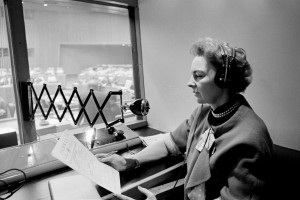
Highly skilled interpreters perform a vital service at UN meetings, where delegates come together to present their views in one of the six official languages or in their own tongue. A UN Interpreter, at work in a booth over looking a meeting room. (1965) UN Photo Feature: UN News Centre 22 September 2014 Out of potential linguistic chaos, a corps of over 100 United Nations interpreters brings order and comprehension as speaker after speaker from around the world takes the podium of the General Assembly to give their annual speeches at the General Debate, discusses war and peace in the Security Council, or delves into arcane details of administrative and budgetary affairs in one of the Assembly’s six specialized committees.
Alexandra Crosby and Tanya Notley Article first published online: 1 JUN 2014
DOI: 10.1111/taja.12085
The Australian Journal of Anthropology, Vol 25 Issue 2 In this paper we examine mediated practices and experiences of online translation and subtitling. Our paper is based on a collaboration with EngageMedia − a not-for-profit organisation based in Australia and Indonesia − and is specifically focused on its work in West Papua. We argue that the video-hosting and online subtitling that is enabled through EngageMedia's websites, while mobilising West Papuan stories in a logical, relatively fast and organised manner, is embedded in a more messy socially-mediated translation process that occurs across shifting scales (local, national, regional, and global), and a range of cultures (online, offline, local, global, networked).
POETRY/TRANSLATION/FILM – POÉSIE/TRADUCTION/FILM PoeTransFi 18-19 June 2015 EMMA, Paul Valéry University, Montpellier, France Please click HERE to download the CFP in PDF format. Scroll down for French version. The aim of this conference, which could also be entitled “The film as poem, the poem as film: A spectrum of translations”, is to revisit the inter-relations between poetry and film, envisaged under the angle of translation, in a broad sense of the term.
Credit Karen Van Dyck Published on June 17, 2014 The PEN Ten is PEN America's biweekly interview series curated by Lauren Cerand. This week Lauren talks to Lawrence Venuti, who translates from Italian, French, and Catalan. His translations include I.U.Tarchetti’s Gothic romance, Fosca, Antonia Pozzi’s Breath: Poems and Letters, Massimo Carlotto’s crime novel, The Goodbye Kiss, and Ernest Farrés’s Edward Hopper: Poems, which won the Robert Fagles Translation Prize. He is the author, most recently, of Translation Changes Everything: Theory and Practice.
Photo: John D. and Catherine T. MacArthur Foundation) By Katrease Stafford, Detroit Free Press Staff Writer 17 September 2014 The 2014 MacArthur Fellows — so-called genius grants — were announced Wednesday morning. One University of Michigan professor is joining a rare class of creative individuals today: Khaled Mattawa is among 21 people from around the country named as 2014 MacArthur Foundation Fellows. In the academic world, the award is known as the "
By Grant Rosenberg/Paris Tuesday, May 15, 2007 Early on in the 2004 supernatural Russian thriller Night Watch, the protagonist, trying to prevent a witch from casting a spell on his unborn child, yells at the top of his lungs in protest. For English-speaking audiences, the subtitles do more than just translate the literal meaning: the words "no" and "stop" with three exclamation points are shown on different parts of the screen in large, moving letters.