by Peter Thompson
Click here to download pdf file: Thompson Subtitles
CONTENTS SUBTITLES: IN GENERALSPATIAL PLACEMENT TIME PLACEMENT SUBTITLING RITUALS SUPERIMPOSITIONS
http://www.chicagomediaworks.com/2instructworks/3editing_doc/3editing_docsubtitles.html
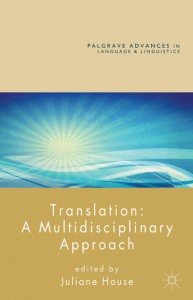
Edited by Juliane House Print Pub Date: August 2014 DOI: 10.1057/9781137025487 ebook ISBNs: 9781137025487 PDF / 9781137025494 EPUB Print ISBNs: 9781137025463 / HB 9781137025494Pages: 290 ppTranslation: A Multidisciplinary Approach provides readers with exciting new insights into the cross-linguistic and cross-cultural practice of translation - a field of rapidly growing international importance. World-renowned experts address the subject from a variety of different perspectives, viewing translation as social action and intercultural communication, as a phenomenon of languages in contact and as a socio-cognitive process.
September 15, 2014 The German Book Office’s Riky Stock spoke to editors and publishers about the factors at play when considering publishing a translation in the US market. By Katharina Rapp
Which foreign books are interesting to American publishers? How do they find these books and who is involved in the translation process? What role does translation funding play and how do the sales and marketing departments deal with translated books?
The Temporary Center for Translation is a site for pedagogical exchange founded on the importance of translation as a mode for thinking, making, and doing.
Every translation sets into play distinct vocabularies and systems of meaning—linguistic and otherwise—and it is in these encounters that priorities and positions are negotiated. While fidelity to an original work or idea is paramount in some theories of translation, the Center questions what exactly constitutes a likeness.
M. Lynx Qualey Fourteen hundred years ago and more, the poet-prince Imru’ al-Qais was banished by his father. The king exiled his son, or so the legend goes, in part because of the prince’s poetry. Thus it was that, when the king was killed by a group of his subjects, al-Qais was traveling with friends. Al-Qais returned to avenge his father’s death, but afterward spent the rest of his life in exile, fleeing from place to place, writing poetry and seeking support to regain his father’s throne.
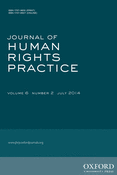
Barbara Moser-Mercer, Leïla Kherbiche and Barbara Class* Journal of Human Rights Practice(2014) 6(1): 140-158. doi: 10.1093/jhuman/hut025 First published online: January 6, 2014 Abstract When communication breaks down, conflict ensues. Resolving conflicts successfully relies heavily on re-establishing communication. Almost all conflicts involve parties who do not speak the same language or share the same culture. Language is the main vehicle of communication under such difficult circumstances, and yet there are few professional interpreters in the field to mediate between languages and cultures.
A decade after the Truth and Reconciliation Committee hearings, the interpreters speak their truth. Yvette Hardie interviews three interpreters, April 2006. Download pdf file of interviews: Invisible Angels.
Special Issue of Altre Modernità – Rivista di studi letterarie e culturali Some of the most crucial developments in translation studies, in the last three decades, have taken place in the field of audiovisual translation (AVT) making it rapidly gravitate from the margins to the centre of academic endeavour in translation. The initial studies on AVT tended to focus on technical and linguistic issues, usually from a descriptive perspective, but more recently academic enquiry in this field has widened in scope by encompassing the socio-cultural and ideological dimensions.
Esperança Bielsa Universitat Autònoma de Barcelona, Spain Published in Cultural Sociology, online before print September 2, 2014, doi:10.1177/1749975514546235 Abstract Whereas globalization theory was predominantly silent about the role of translation in making possible the flow of information worldwide, assuming instant communicability and transparency, translation has gained central importance in recent accounts of cosmopolitanism that emphasize global interdependence and the negotiation of difference. In this context, a specification of translation processes provides a way of analysing the form in which interactions between different modernities take place and of specifying a notion of cosmopolitanism as internalization of the other.