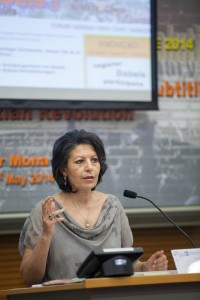
Professor Martha Cheung Memorial Lecture, May 2014, Hong Kong Baptist University Mona Baker, Centre for Translation & Intercultural Studies, University of Manchester The idea of prefiguration originally derived from anarchist discourse; it involves experimenting with currently available means in such a way that they come to mirror or actualize the political ideals that inform a movement, thus collapsing the traditional distinction between means and ends. Practically all the literature on prefiguration has so far focused on structural, organizational and interactional issues.
09/06/2015, 2 PM, County Main SR5 The Arab and Muslim Worlds Research Forum invites you to: Language Gender and the Egyptian Revolution: An interactive workshop Presenter: Shaimaa El Naggar (LAEL) Discussant: Dr Shuruq Naguib (PPR) Produced in 2012, “Words of women from the Egyptian revolution” is a YouTube series about women’s engagement in the Egyptian uprisings, directed by Leil Zahra Mortada. Each YouTube video interviews women who reflect upon their participation in the Egyptian uprisings that started in 2011.
Egypt Today 21 September 2013 A new project to shed light on women’s role during January 25 By Nadine El Sayed After January 25, people thought feminism will finally get its break in Egypt, only to be faced with an unrepresentative female minority in the parliament, a crackdown on women’s march last year and an overall undermining of women’s role in the political scene.But Words of Women from the Egyptian Revolution documentary series hopes to contribute in writing history through telling and highlighting women’s stories duringJanuary 25, as told by them.
By Ahmed Refaat Mada Masr, 15 March 2015 I first heard Mona Baker two months ago in a workshop organized by the Imaginary School Program at Beirut, the art space not the city. It was called: “Prefigurative politics and creative subtitling.”
During the three-hour event, Baker briefly summed up what she discusses more elaborately in her research project, “Translating the Egyptian Revolution,” which “examines the language-based practices that allow Egyptian protesters to contest dominant narratives of the revolution and, importantly, to connect with, influence and learn from global movements of protest.